Blog

  • Manchester’s Number 1 AI Consultants: Why CCwithAI Leads the Way in 2026

    Manchester’s Number 1 AI Consultants: Why CCwithAI Leads the Way in 2026

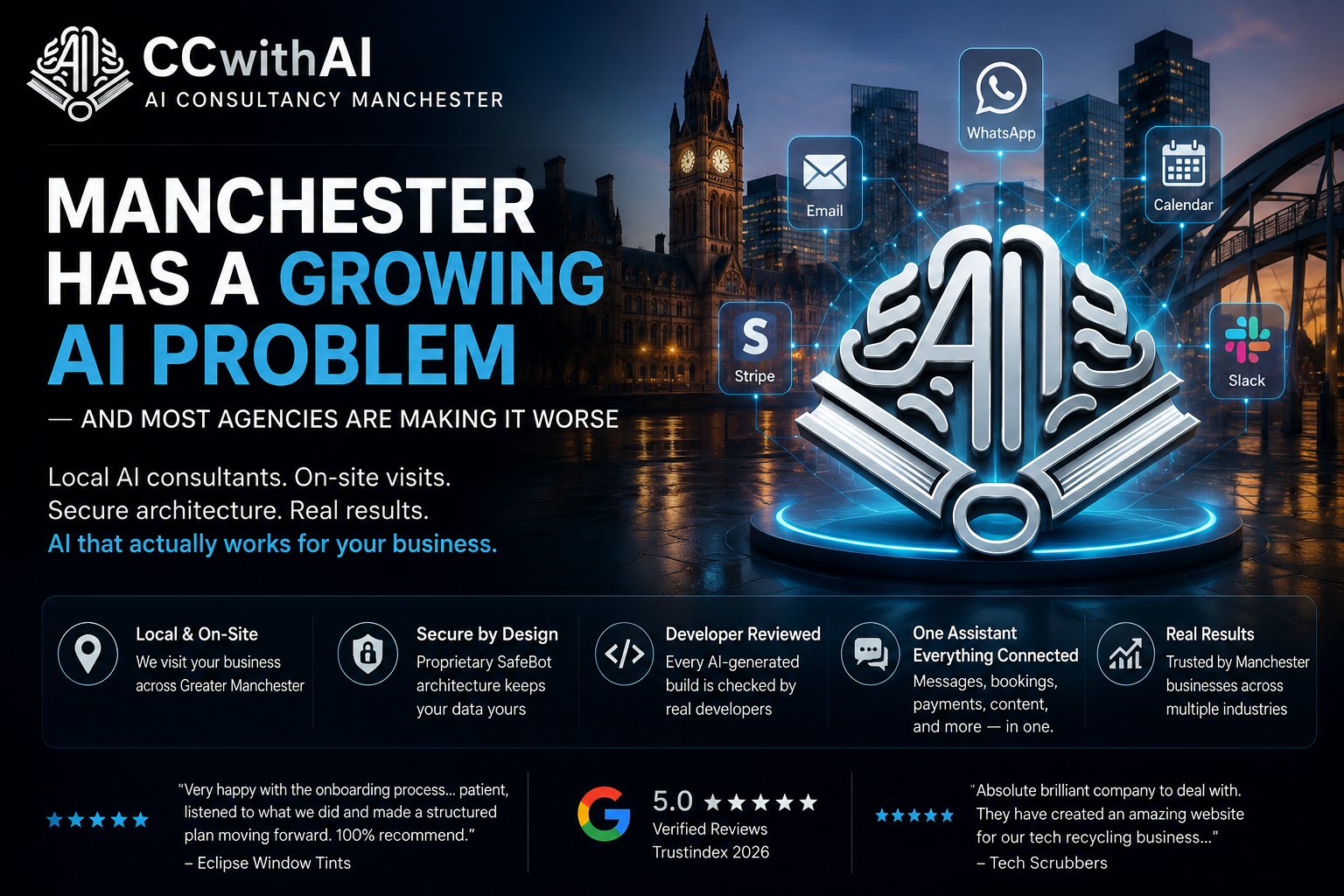
    Manchester Has a Growing AI Problem — and Most Agencies Are Making It Worse

    You’ve probably noticed it. Every week there’s a new “AI agency” promising to transform your business. Most are London-based firms doing discovery calls over Zoom. A few are one-person operations selling ChatGPT wrappers. Some charge £3,000 just to run a “pilot” before they’ll tell you if the thing actually works.

    Manchester businesses deserve better than that. And increasingly, they’re finding it.

    CCwithAI has quietly become the go-to AI consultancy for businesses across Greater Manchester — not through slick marketing, but through a track record of showing up, listening, and building things that actually work. This post explains exactly why.

    What Makes the Best AI Consultants in Manchester Different?

    The difference between a good AI consultant and a bad one isn’t technical. It’s contextual. Anyone can install a chatbot. The question is whether it knows your business, speaks in your voice, connects to your tools, and actually handles real work — or whether it breaks the moment a customer asks something unusual.

    CCwithAI focuses on the latter. Their approach starts not with a product demo, but with an on-site consultation where they watch how your business actually operates. Most agencies skip this entirely. CCwithAI considers it non-negotiable.

    “Very happy with the onboarding process, we had no idea how to use AI in our business and CCwithAI was patient, listened to what we did in our business and made a structured plan moving forward. 100% recommend.” — Eclipse Window Tints

    The CCwithAI Approach: Why Manchester Businesses Keep Coming Back

    There are five things CCwithAI does that most AI consultants in Manchester simply don’t.

    1. They Come to You

    CCwithAI offers free on-site consultations across Greater Manchester. They come to your premises, observe your workflow, and leave you with a wireframe of your proposed AI assistant — a visual plan showing exactly what it will do and how it connects to your systems. You keep this whether you hire them or not.

    Compare this to agencies that charge for an initial strategy session and deliver a 40-page PDF with no clear next step. If you’re unsure what questions to ask, our guide on how to choose the right AI consulting service in Manchester is a good starting point.

    2. They Build One Assistant That Handles Everything

    Rather than selling separate tools for separate problems, CCwithAI builds a single AI assistant that handles customer messages, bookings, payments, invoicing, content, reporting, and team communications — all in one. It connects to WhatsApp, email, Stripe, your calendar, and your team’s Slack or group chat.

    For a detailed look at how this works in practice, see how CCwithAI built a private WhatsApp AI agent and admin dashboard for local businesses — including the architecture decisions behind keeping your data secure.

    3. Their Security Architecture Is Genuinely Different

    This is the one most businesses don’t think to ask about — until something goes wrong.

    Most AI automation agencies use off-the-shelf platforms that route your business data through third-party servers you’ve never audited. CCwithAI built their own internal AI system (called SafeBot) using a different philosophy: credentials stored in secure private repositories, CLI integrations with proper authentication, and every AI-generated piece of code reviewed by a full-stack developer before it goes live.

    A good example of this depth is their three-layer AI system for review management — combining RAG retrieval, a graph layer, and a fine-tuned LLM to produce responses that are accurate, brand-consistent, and Google-compliant. That level of engineering isn’t possible with off-the-shelf tools.

    Your data stays yours. That’s not a marketing line — it’s a technical architecture decision.

    4. Real Developers Are in the Loop

    AI writes code fast. That’s also how security vulnerabilities appear fast. CCwithAI’s model keeps human developers in the review cycle: AI generates, developers check, test, and sign off. Nothing reaches a real customer without that sign-off.

    For Manchester businesses handling customer data, payments, or appointment bookings, this matters enormously.

    5. They Have a Track Record Across Manchester Industries

    CCwithAI has worked with businesses ranging from bathroom fitters and plumbers to tech recyclers, car dealers, and e-commerce brands. Their client reviews tell the same story repeatedly: results are real, the team is approachable, and the implementation is fast.

    For a deeper look at specific project outcomes, read their post on AI consultants Manchester: real projects, real results for local businesses.

    “We have used CCwithAI for SEO and Google Maps profile services — it has been a game changer. Regular, consistent calls from customers and orders. Highly recommended. They have made our quiet few-orders-a-day site into much more.” — Plate Monkey

    “Absolute brilliant company to deal with. They have created an amazing website for our tech recycling business and they also do all our SEO and marketing. Do not hesitate to use them!” — Tech Scrubbers

    CCwithAI vs Other Manchester AI Consultancies: How Do They Compare?

    FactorCCwithAITypical Manchester AI Agency
    LocationManchester-based, on-site visitsOften London-based or remote-first
    Initial consultationFree, on-site, with wireframePaid discovery call or generic audit
    Security modelProprietary SafeBot architectureThird-party platforms and connectors
    Developer oversightEvery build reviewed by developersAutomated, no human review
    IntegrationWhatsApp, Stripe, email, calendar, SlackUsually 1–2 integrations in basic tiers
    Pricing transparencyClear, outcome-basedOften hidden behind pilot fees
    Verified reviews5.0 — Trustindex 2026Varies

    What Can CCwithAI Actually Do for Your Manchester Business?

    Here’s what the AI assistant CCwithAI builds can handle day to day:

    • Customer messages: Reads and replies to WhatsApp, email, and enquiry forms in your tone of voice — instantly, 24/7. No more missed leads at 9pm.
    • Bookings and scheduling: Takes bookings, checks availability, sends confirmations, and follows up automatically.
    • Payments and invoicing: Connected to Stripe — sends payment links, chases overdue invoices, confirms payments.
    • Content and social media: Drafts blog posts, social captions, and Google Business updates in your brand voice. You approve, it publishes.
    • Reporting and admin: Pulls together daily summaries, flags problems, keeps paperwork moving.
    • Voice and team comms: Joins your Slack or team chat to answer questions and surface information around the clock.

    None of this requires you to change the tools you already use. It connects to them. For a full breakdown of the service categories available, see the ultimate guide to AI services for Manchester businesses.

    AI Consulting Manchester: What to Look for in 2026

    The AI consultancy market in Manchester has changed quickly. In 2024, most agencies were selling chatbots. In 2025, the offer expanded to automation workflows. In 2026, the question businesses are asking is sharper: who actually understands my business, and who’s just reselling an off-the-shelf platform?

    The honest answer is that many agencies — even well-reviewed ones — are doing the latter. They connect your data to a third-party workflow tool, configure a few automations, and call it bespoke. When something breaks, the support chain is three companies long.

    CCwithAI builds directly. When something needs changing, there’s one team to call. And because they built it, they can actually change it.

    Frequently Asked Questions About AI Consultants in Manchester

    How much does an AI consultant cost in Manchester?

    Freelance AI consultants in the UK typically charge £500–£900 per day. Agencies charge more, but offer full delivery and ongoing support. CCwithAI works on a project basis with clear, outcome-focused pricing — contact them for a quote specific to your business. The free initial consultation means you know exactly what you’re getting before any money changes hands.

    What industries does CCwithAI work with in Manchester?

    CCwithAI has delivered AI solutions across trades (plumbing, bathrooms, window tinting), automotive, e-commerce, and tech services. Their approach is industry-agnostic — the consultation process is how they learn your specific workflow before building anything. See their real projects and results for examples across different sectors.

    How long does it take to implement an AI assistant for my business?

    Most implementations go live within a few weeks of the initial consultation. Complex multi-system integrations take longer, but CCwithAI’s process is designed to move quickly from plan to working system — not from plan to another plan.

    Is my business data safe with an AI consultant?

    It depends entirely on how the agency builds. CCwithAI’s SafeBot architecture keeps your credentials in secure private repositories and uses proper authentication — not third-party connectors that scatter your API keys across platforms you’ve never audited. Ask any AI consultant exactly where your data lives. If they can’t answer clearly, that’s your answer.

    What are the main benefits of using an AI automation agency as an SME?

    The headline benefits are reduced admin time, 24/7 customer response capability, lower operational costs, and faster lead conversion. For a detailed breakdown, read the post on the top 5 benefits of an AI automation agency for SMEs.

    Can AI replace my customer service team?

    The realistic answer is that AI handles volume — routine enquiries, booking confirmations, payment chasing, FAQ responses — while your team handles complexity and relationship-building. A well-configured AI chatbot for UK businesses can capture leads and qualify enquiries around the clock, meaning your team picks up warm conversations rather than cold ones.

    Can CCwithAI help my business with Google Maps and local SEO as well as AI?

    Yes. Beyond AI assistants, CCwithAI offers local SEO and Google Maps ranking services specifically designed to get Manchester businesses into the top 3 of the Google Map Pack — where the majority of local search clicks go. Several of their clients have seen measurable increases in calls and orders within months.

    How do I get started with CCwithAI?

    Book a free consultation via the CCwithAI website or call 0330 043 1178. They’ll arrange an on-site visit, learn how your business works, and leave you with a wireframe plan — at no cost and with no obligation. You can also read the guide to choosing the right AI consulting service to know what questions to ask before committing to any agency.

    Ready to Work with Manchester’s Number 1 AI Consultants?

    The businesses that are winning in Manchester right now aren’t the ones who spent six months evaluating AI. They’re the ones who found the right partner, got a clear plan, and started.

    If you want to know exactly where AI fits in your business — not in theory, but in practice, with your tools, your customers, and your team — CCwithAI is the right starting point.

    Book your free on-site consultation today or call 0330 043 1178. No sales pitch, no jargon, no obligation — just a clear plan for your business.

  • AI Consultants Manchester: Real Projects, Real Results for Local Businesses

    AI Consultants Manchester: Real Projects, Real Results for Local Businesses

    You keep hearing about AI. You’re not sure if it’s right for your business. And the last thing you want is to pay thousands of pounds for something that doesn’t actually help. We get it. We’re CCwithAI — AI consultants based in Manchester — and this post shows exactly what we’ve built for real UK businesses and what it saved them.

    Most businesses we speak to have the same worry: “AI sounds great, but I don’t know where to start.”

    You’re running a business. You don’t have time to read 40-page tech reports. You just want to know: will this save me time? Will it save me money? Will it actually work?

    So instead of telling you what AI can do, we’re going to show you what it has done — for businesses just like yours, right here in the UK.


    What AI Consultants in Manchester Actually Do

    An AI consultant isn’t someone who sells you a chatbot off a shelf and disappears. A good AI consultant listens to how your business works, finds the boring or repetitive bits, and builds something that handles those bits automatically.

    That could be:

    • A tool that replies to customer enquiries at 3am so you don’t have to
    • A system that reads your reviews and writes professional replies in seconds
    • A dashboard that shows you everything happening in your business in one place
    • An AI trained to do a specific job your team currently does by hand

    The key word is custom. Off-the-shelf tools are fine for some things. But if you want something that fits your business perfectly — something your competitors can’t just go and buy — you need it built for you.

    That’s what we do at CCwithAI.


    Real Projects We’ve Built for UK Businesses

    Here are some of the tools we’ve built recently. We’re not sharing every detail — our clients’ businesses are their own — but we want you to see how we work and what’s possible.

    Local Business — WhatsApp & Admin

    A Private WhatsApp AI Agent with a Secure Admin Dashboard

    A local service business came to us with a problem. Their team was spending hours every day answering the same questions on WhatsApp: “What are your prices?” “Are you available on Saturday?” “How long does it take?”

    We built them a private AI agent that lives inside WhatsApp. It answers customer questions, takes details, and passes the right jobs to the right people — all automatically. No customer ever knows they’re talking to an AI.

    We also built a secure admin dashboard so the business owner can see every conversation, update the AI’s answers, and track what’s happening — all from their phone or laptop.

    The system is completely private. Customer data doesn’t go through third-party servers. It stays within their own secure backend.

    ✅ Result: Staff saved around 2–3 hours per day on routine messages. The owner now checks a single dashboard instead of scrolling through hundreds of WhatsApp threads.
    Reputation — AI Review Responder

    A Three-Layer AI System That Manages Google Reviews

    One of our clients was getting dozens of Google reviews every week. Some were glowing. Some were complaints. Writing good replies to all of them was taking their manager over an hour a day — and they were sometimes missing negative reviews that needed urgent attention.

    We built a three-layer AI system. The first layer reads the review and understands the mood — happy, unhappy, or somewhere in between. The second layer checks past reviews to make sure the reply sounds like the business, not like a robot. The third layer spots patterns: if several customers mention the same problem, it flags it so the owner knows before it becomes a crisis.

    Everything stays Google-compliant. Replies are written in the business’s own voice. The owner approves them with one click.

    ✅ Result: Review response time dropped from 24–48 hours to under 10 minutes. Problem patterns were spotted weeks earlier than before.
    E-Commerce — AI Investigation Tool

    An AI Trained to Investigate Missing Parcels

    A major online retailer had a growing problem with missing parcel claims. Customers were reporting damaged or missing deliveries. Staff had to investigate each one manually — checking photos, reading descriptions, cross-referencing data. It was slow, expensive, and inconsistent.

    We trained an AI to do this investigation automatically. It looks at the photos customers send, reads the delivery notes, checks the order history, and makes a recommendation — all in seconds. Staff only step in for edge cases.

    We trained the AI specifically on this retailer’s cases, so it gets smarter the more it works. It knows the difference between a genuine claim and one that doesn’t quite add up.

    ✅ Result: Investigation time per case dropped by over 80%. The team could handle three times as many cases without hiring extra staff.
    Lead Generation — AI Chatbot

    A Lead Capture Chatbot Starting From £250

    Not every business needs a complex system. Sometimes the biggest win is simply making sure you never miss a lead again.

    We built a series of AI chatbots for small businesses that sit on their website. When a visitor arrives at 11pm and has a question, the chatbot answers it, collects their name and contact details, and sends the business owner a summary in the morning. No missed enquiries. No lost leads.

    These start from just £250 — a one-off cost — and can be set up in days. If you’re losing even one or two customers a month because nobody was available to answer, this pays for itself almost immediately.

    ✅ Result: Multiple clients reported capturing leads they would have previously missed completely, especially from evening and weekend traffic.

    Why a Custom Backend Matters (And Why Most Businesses Don’t Know to Ask)

    Here’s something we tell every new client: the backend is just as important as what you see on screen.

    A “backend” is the engine running behind your website or tool. You never see it, but it’s where your data lives, where your AI processes information, and where your security either holds or breaks down.

    Many cheap AI tools use shared backends. Your customer data goes through their servers. You’re trusting a third party with information your customers gave to you. That’s a risk — both legally and in terms of trust.

    When we build something for you, we build you a private, secure backend. Your data stays yours. Nobody else can access it. And because it’s built around your business, it works exactly the way you need it to — not the way an off-the-shelf tool forces you to work.

    A good custom backend also saves money in the long run. You’re not paying monthly fees to five different tools. You have one system, built for you, that grows with your business.


    How We Work With You: Our Process

    We know that hiring an AI consultant can feel daunting if you’ve never done it before. So here’s exactly what happens when you work with us.

    We Listen First

    We start with a free call. No tech talk, no sales pitch. We just want to understand what you do, what slows you down, and what you wish happened automatically. You don’t need to know anything about AI for this conversation.

    We Find the Best Starting Point

    After the call, we put together a simple plan. We show you what we think would help most, how long it would take to build, and what it would cost. No jargon. No hidden fees. You decide if you want to go ahead.

    We Build It Around Your Business

    Everything we build is custom. We don’t use templates and rename them. We build from scratch, around how you actually work. You’re involved at every stage — we show you what we’re building and get your feedback as we go.

    We Hand It Over — Simply

    When it’s ready, we walk you through it. We make sure you know how to use it, what to do if something doesn’t look right, and how to get hold of us if you need us. We don’t disappear once the project is done.

    We Keep It Running

    AI tools need occasional updates as your business changes. We offer ongoing support so your system stays sharp. And if you want to add something new, we’re already familiar with your setup — which keeps costs down.


    How Much Can AI Actually Save a Manchester Business?

    Every business is different, but here are some realistic numbers based on what our clients have seen.

    2–3 hrs Saved per day on customer messages
    80% Faster investigation for complex cases
    More cases handled without extra staff
    From £250 Entry point for smaller businesses

    If you pay a team member £12 an hour and they spend three hours a day on tasks an AI could handle, that’s £36 a day — £900 a month — on work a machine could do for a fraction of the cost. And unlike a person, the machine works nights, weekends, and bank holidays without complaint.

    That’s not about replacing people. It’s about giving your people more time to do the things that actually need a human.


    Ready to See What AI Could Do for Your Business?

    We offer a free, no-pressure call to any Manchester business thinking about AI. We’ll tell you honestly what would help and what wouldn’t. No jargon, no hard sell.

    Talk to CCwithAI →

    Frequently Asked Questions

    What does an AI consultant in Manchester do?

    An AI consultant helps your business use artificial intelligence to save time and money. They look at the tasks your team does every day, find the ones that could be automated, and build tools to handle them. A good consultant makes the whole process simple — you don’t need any tech knowledge to work with us.

    How much does AI consultancy cost in Manchester?

    It depends on what you need. Simple tools like a lead capture chatbot can start from £250. More complex systems — like a custom WhatsApp AI agent with a private backend — typically cost more. We always give you a clear price before any work starts, with no hidden fees.

    Do I need to understand AI to use these tools?

    Not at all. We build everything so it’s easy for you to use from day one. You won’t need to write any code or learn any complicated software. If you can use a smartphone, you can use the tools we build.

    Is my customer data safe with a custom AI system?

    Yes — and this is one of the main reasons we build custom rather than using off-the-shelf tools. Your data stays in your own private, secure backend. It doesn’t pass through third-party servers. We take data security seriously and build every system with this in mind.

    How long does it take to build an AI tool for my business?

    Simple tools can be ready in a few days. More complex systems typically take two to six weeks, depending on what we’re building. We give you a clear timeline before we start and keep you updated throughout.

    Can a small business in Manchester afford AI?

    Yes. Some of our best projects have been for very small businesses with tight budgets. We can start small — with one tool that solves one problem — and add more over time as you see the results. You don’t have to transform your whole business overnight.

    What kinds of businesses do you work with?

    We work with all kinds — retailers, service businesses, e-commerce stores, professional services, and more. If your business has repetitive tasks, missed enquiries, or processes that feel slow, there’s almost certainly something AI can help with. We’re happy to have a free call and tell you honestly what’s possible.

    Do you offer ongoing support after the project is finished?

    Yes. We don’t hand over the keys and disappear. We offer ongoing support to keep your AI tools running well and update them as your business changes. Because we built it, we already know how it works — which makes any updates faster and cheaper.

  • The AI Chatbot Transforming How UK Businesses Capture Leads — From £250

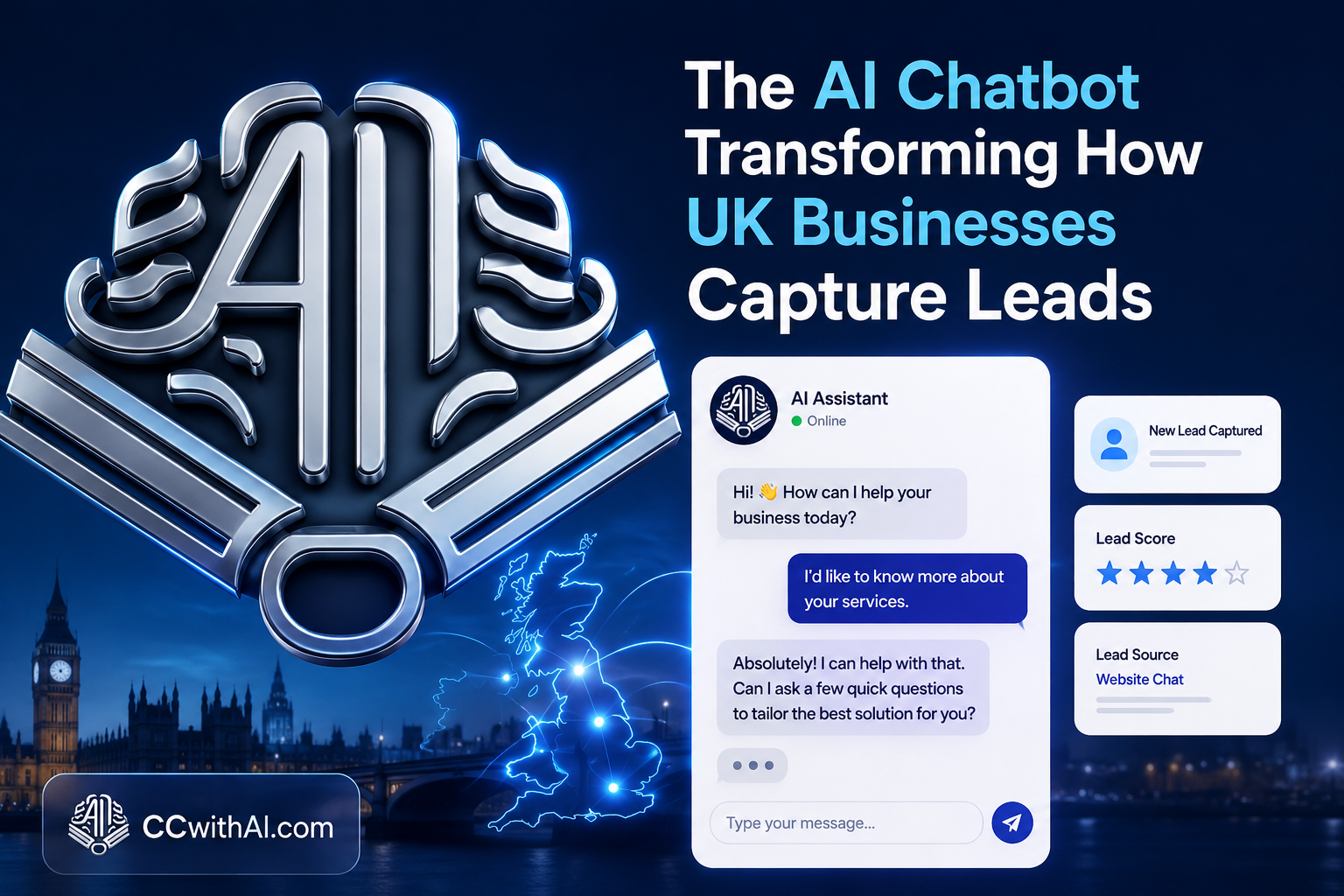
    The AI Chatbot Transforming How UK Businesses Capture Leads — From £250

    If you’ve visited CCwithAI.com, you may have already spoken to it without realising how much is happening beneath the surface.

    What looks like a simple chat widget is a fully orchestrated AI system — one that books appointments, verifies identities, captures leads, escalates urgent enquiries, and sends professional confirmation emails, all without a human touching a keyboard.

    This is what next-generation AI looks like. And it starts from £250.


    The Problem With Traditional Business Chatbots

    Most businesses are still running chatbots that belong in 2019. You know the type — rigid decision trees, “I didn’t understand that, can you rephrase?”, and a final “Would you like to speak to a human?” that leads nowhere at midnight.

    These tools frustrate customers, miss leads, and give businesses a false sense of automation. The real problems remain unsolved:

    • Leads arriving at 2am with no one to respond
    • Booking enquiries scattered across inboxes
    • Customers asking the same invoice questions repeatedly
    • No way for clients to access their own data securely
    • GDPR obligations creating friction at every touchpoint

    A properly built AI system solves all of this.


    What’s Running Under the Hood

    The chatbot on CCwithAI.com runs on a production-grade stack:

    • GPT-4o via OpenRouter as the core language model
    • LangChain.js for orchestration and tool-calling
    • pgvector on Supabase for semantic document search (RAG)
    • Resend for transactional emails
    • Cloudflare Turnstile — invisible CAPTCHA, zero friction for real users
    • Next.js App Router with real-time streaming responses

    This isn’t a chatbot pretending to be smart. It’s a multi-agent AI system that adapts its behaviour based on who it’s talking to.


    Three Audiences, One Interface

    The system serves three distinct user types through the same widget:

    1. Anonymous Visitors — Lead Capture Mode

    When someone starts chatting, the AI enters lead-generation mode immediately. It detects intent, not just keywords. If someone says “I want to book a consultation,” the bot skips discovery questions and goes straight to data capture.

    After two exchanges, a smooth email prompt appears. Behind the scenes, the address is validated, rate-limited, checked for duplicates within 24 hours, and stored — all with invisible bot protection running silently in the background.

    2. Authenticated Clients — Secure Self-Service Mode

    Logged-in clients get a completely different experience. They can query their own documents, check invoices, and message the team — all within the same widget. The AI knows who they are and retrieves only their data.

    3. Admins — Control Tower Mode

    Admins see a full dashboard: live analytics, lead management, knowledge base uploads, inbox management, and client conversation threads. Unread messages surface with animated badges, and all captured leads export to CSV.


    The Booking System: Intent-First Intelligence

    This is where the chatbot earns its cost back within days.

    Traditional booking bots ask twenty questions before getting to the point. The CCwithAI system uses Intent-First Fasttrack Logic — when a user has already stated what they want, the AI recognises it and moves straight to capture.

    A booking triggers a full automated workflow:

    1. The AI collects name, email, phone number, preferred time, and contact method
    2. A priority notification fires to the business owner immediately
    3. A professional confirmation email goes to the lead with their booking details
    4. The enquiry is logged in the database and appears in the admin dashboard
    5. The admin can reply, view the full thread, and manage the relationship from there

    All of this runs whether it’s 2pm on a Tuesday or 3am on a Sunday. No leads fall through the cracks.


    DPA Verification: GDPR Done Properly

    Here’s something most chatbot vendors don’t attempt: built-in Data Processing Agreement verification.

    When a client requests invoice data through the chatbot, the system doesn’t just hand it over. It runs a three-step identity check:

    1. Email match — the address provided must match their authenticated account
    2. Postcode check — fuzzy-matched against their stored profile (whitespace and case normalised)
    3. Name verification — first-name substring matching against stored records

    Only when all three pass does the system respond with invoice data. Any failure returns a clear message with the specific reason.

    For businesses handling client financial data, this isn’t a nice-to-have — it’s a legal requirement. Having it baked into the AI conversation flow means it’s impossible to bypass and needs no manual oversight.


    The Knowledge Base: AI That Knows Your Business

    The chatbot doesn’t work from generic internet knowledge. It uses Retrieval-Augmented Generation (RAG) — the AI searches a private, business-specific knowledge base before every response.

    Admins upload content directly from the dashboard. Each piece is converted into a 1,536-dimension vector embedding using OpenAI’s text-embedding-3-small model and stored in a PostgreSQL vector database. When a user asks a question, the system finds the three most semantically relevant chunks and feeds them into context.

    The chatbot answers questions about your services, your pricing, your processes — not generic platitudes.


    Urgent Escalation: The Receptionist That Never Sleeps

    When a visitor uses urgent language, the system detects it and triggers a priority response immediately:

    • A red-flag notification goes to the business owner
    • The conversation is marked high priority in the admin inbox
    • The lead is captured with escalation metadata

    For businesses where a single urgent enquiry is worth thousands, this feature alone justifies the investment.


    What’s Included From £250

    Core

    • GPT-4o conversational AI with intent detection
    • Fast-track booking capture
    • Automated confirmation and admin notification emails
    • Real-time streaming responses

    Lead Management

    • Email capture with duplicate detection and rate limiting
    • Invisible CAPTCHA bot protection (10 requests / 10 min per IP)
    • CSV export of all leads

    Data Compliance

    • 3-step DPA verification for sensitive data access
    • GDPR-aligned capture with consent tracking
    • Role-based data access — clients see only their own data

    Admin Dashboard

    • Live analytics (leads, messages, subscribers)
    • Knowledge base management
    • Bot configuration (system prompt, welcome message, capture text)
    • Client management with DPA fields
    • Bidirectional client-admin messaging

    Email System

    • Professional HTML confirmation emails via Resend
    • Urgent escalation and SEO report request notifications

    Security

    • Cloudflare Turnstile invisible CAPTCHA
    • Supabase Row Level Security
    • Server-side session validation

    Why This Is Different

    The gap between a £50/month SaaS chatbot and a purpose-built AI system isn’t features — it’s architecture. Generic tools bolt AI onto a chat widget. This is a system where the AI is the business logic layer.

    It qualifies leads from conversation context, executes workflows as LangChain tool calls, persists every interaction with full thread history, adapts its persona by authenticated role, and learns from admin-managed content.

    That’s the difference between a chatbot that costs you money and one that makes you money.


    Ready to Deploy This for Your Business?

    Whether you’re a local service business missing overnight enquiries, a professional services firm needing GDPR-compliant client self-service, or a brand wanting to cut support load — this scales to your needs.

    From £250, fully deployed. Booking, email automation, DPA verification, and a live admin dashboard included.

    Book a free consultation → | See it live →

    Built on: Next.js · GPT-4o · LangChain.js · Supabase · Resend · Cloudflare Turnstile

  • How We Built a Private WhatsApp AI Agent & Admin Dashboard for Local Businesses

    How We Built a Private WhatsApp AI Agent & Admin Dashboard for Local Businesses

    In today’s fast-paced digital economy, local service businesses face a massive operational bottleneck: response time. When a customer messages your business on WhatsApp inquiring about availability or pricing, every minute of delay decreases the chances of closing that deal. Research shows that replying within 5 minutes increases conversion rates by up to 391%.

    To solve this critical pain point, we designed and built a bespoke, private WhatsApp AI Integration tailored for service businesses like Cleaner in Manchester (0161) Ltd. Combining a high-performance Go bridge, a robust Python AI engine, and a premium custom Dashboard, this integration empowers local businesses to operate 24/7 with the intelligence and speed of an automated team member.

    🚀 The Customer Experience: Immediate, Context-Aware Responses

    Unlike generic chatbots that output frustrating “if-else” menu responses, our integration leverages a state-of-the-art local 27B parameter reasoning LLM (Qwen 3.6). When a customer asks for pricing or makes booking requests, the bot understands the context, performs semantic vector retrieval, and outputs highly specific, natural, and accurate responses. Look at this real, verified example:

    Customer: “Thanka can I book that then”
    AI Assistant: “Hi Alex 👋 Thanks for sending those details over. For a 2-bed deep clean, our flat rate is £175. To secure the slot for tomorrow at 2pm, we just need a £50 secure booking fee upfront (this is fully deducted from your final bill, so it’s not an extra charge). I’ll get this arranged and send you a confirmation shortly 📝 Let me know if you’d like to add any extras like oven or fridge cleaning!”

    🧠 Self-Training Knowledge Base: Chunked and Vector-Indexed Locally

    How does the AI know the business inside and out? The secret lies in a fully automated, private RAG (Retrieval-Augmented Generation) pipeline. We ingest all historical customer chat records and business documents, which are then:

    • Smart-Chunked: Broken down into high-context conversational and informational blocks.
    • Intelligently Vector-Indexed: Converted into multi-dimensional embeddings and stored securely in a local, private SQL Server database.
    • Dynamically Retrieved: Whenever a customer asks a question, the engine performs a lightning-fast cosine similarity lookup to find the most relevant pricing and service guidelines, feeding them directly into the reasoning model.

    🔒 Super Private: 100% Secure, In-House Infrastructure

    Data privacy is a major concern when using AI for customer relations. Standard SaaS solutions send all your customer conversations, phone numbers, and company secrets to external cloud servers, exposing you to compliance risks. Our solution is SUPER PRIVATE:

    • The entire AI reasoning model and embedding pipelines run on your own secure local server (or private cluster).
    • Customer chat histories, databases, and logs are kept strictly within your private networks.
    • No customer data is ever used to train public models, ensuring full GDPR and regulatory compliance.

    📢 Automated Broadcast Marketing via Cron Jobs

    Beyond automated customer replies, the integration features a powerful Broadcast Marketing Engine. Directly controlled from the Bot Configuration panel, you can schedule and dispatch bulk WhatsApp marketing campaigns to past clients or leads using custom cron triggers (e.g. sending a weekend cleaning special every Monday at 9:00 AM). The bot manages cooldowns, daily caps, and compliance limits automatically to ensure perfect deliverability.

    📊 Deep Interaction Analytics & Service Improvement

    Every message that passes through the integration represents an opportunity to improve. The SQL database serves as an invaluable asset for deep analytics:

    • Customer Sentiments & Trends: Spot spikes in specific booking requests (such as high demand for carpet cleaning in spring) or common operational questions.
    • Service Optimization: Use historical conversation flows to continuously refine the bot’s tone, upgrade your custom RAG knowledge base, and identify bottlenecks in your operational workflows.

    🎨 A Premium Admin Dashboard with AI Reply Assistant

    While the AI operates fully automatically in the background, business owners need total control. We built a gorgeous web dashboard featuring:

    • Dual Chat History: View both incoming messages and outgoing messages in real-time, styled as native WhatsApp-style message logs with clean color alignment (green sent bubbles on the right, gray received on the left).
    • AI Reply Assistant: Clicking on any active conversation brings up a custom suggestion panel. With a single click, business owners can generate a perfect, RAG-guided draft, edit it if necessary, and send it directly to the customer’s phone via the bridge.

    🔌 Bespoke CRM & Existing Flow Integrations

    This solution isn’t a standalone silo—it connects directly to your existing systems. We can seamlessly sync the database with your current CRM platforms, automatically updating lead statuses, updating customer contact records, and triggering specific manual-review notifications to your office staff based on chat milestones (e.g. marking a lead as ‘Paid’ the moment a booking fee is captured).

    ⚙️ Under the Hood: The Tech Stack

    We believe in keeping applications reliable, fast, and secure. The architecture consists of three core components:

    1. High-Performance Go Bridge (whatsmeow): Built with Go, our bridge runs directly in a lightweight container, maintaining a stable, low-latency connection to the WhatsApp Web protocol. It synchronizes incoming/outgoing messages instantly into a local SQLite database.
    2. The Python AI Engine (APScheduler): Running as a background daemon, a lightweight Python service polls the SQLite database every minute for unprocessed customer messages. It implements a robust multi-stage pipeline: classification, embedding-based RAG lookup, and reasoning reply generation.
    3. Permanent SQL Audit Trails: All bot classifications, skip actions, and reply histories are written to a secure Microsoft SQL Server database, providing a permanent and reliable audit trail for compliance, performance analytics, and training iteration.

    🛑 Human-in-the-Loop & Anti-Double-Reply Protection

    One of the biggest problems with automated chat systems is when a human staff member replies to a customer on their phone, but the bot continues to auto-reply, creating a confusing and spammy experience. Our system solves this with an already-answered check: before generating any AI reply, the engine checks the absolute latest message in the conversation. If the last message was sent by the business, the bot immediately steps back and goes to sleep, letting the human staff take over seamlessly.

    ✨ Fully Implemented Core Integrations

    To deliver a truly professional, hands-free booking experience, we have successfully integrated these advanced third-party pipelines directly into the bot’s runtime:

    • 📅 Synchronized Booking Calendar: The bot now automatically creates or updates customer records in a dedicated schedule database upon deposit verification. Confirmed clean dates, prices, addresses, and contact emails are perfectly tracked and visually structured in a premium Admin Calendar.
    • ✉️ Transactional Resend API Emails: The bot leverages the ultra-reliable Resend API to dispatch high-end HTML booking confirmations directly to the client’s email upon payment receipt.
    • 🛡️ Multi-Recipient & Rate-Limit Buffering: In a single operational flow, the bot automatically emails the client, waits exactly 30 seconds to strictly respect Resend API account limits, and then dispatches a notification copy to the site admin (info@0161cleanerinmanchester.co.uk) for seamless operations.

    🔮 Future Integrations

    Because this platform is private and fully customizable, we can extend this integration with additional powerful triggers:

    • 💳 Stripe API Integration: The bot can automatically generate secure, dynamic Stripe payment links when booking fees or flat rates are quoted, letting customers pay and secure their booking instantly inside the chat.
    • ✉️ Invoice Automation: Triggering custom flows (such as generating a PDF invoice and emailing it to the client) the moment a booking is finalized.
    • 🔄 Post-Service Workflows: Trigger custom actions—like sending an automated customer satisfaction survey exactly 24 hours after a completed job.

    By owning their own AI infrastructure, local businesses can eliminate expensive SaaS subscriptions while offering a hyper-premium, instant customer experience that beats the competition every single time. It’s not just a chatbot—it’s a bespoke digital employee.

  • We Built a Three-Layer AI System That Replies to Reviews, Stays Google-Compliant, and Spots Problems Before They Become Crises

    We Built a Three-Layer AI System That Replies to Reviews, Stays Google-Compliant, and Spots Problems Before They Become Crises

    Most businesses treat customer reviews as a chore. Reply to the good ones, apologise for the bad ones, move on. The replies are rarely strategic, often generic, and — if you’re using off-the-shelf AI — frequently sound like they were written by the same robot replying to every business in the country.

    We built something substantially different. What started as a solution to a simple problem — helping our clients reply to reviews faster without losing their brand voice — evolved into a three-layer AI system that does things no generic tool can do.

    Here’s what we built, how it works, and why it matters.

    The Three Layers

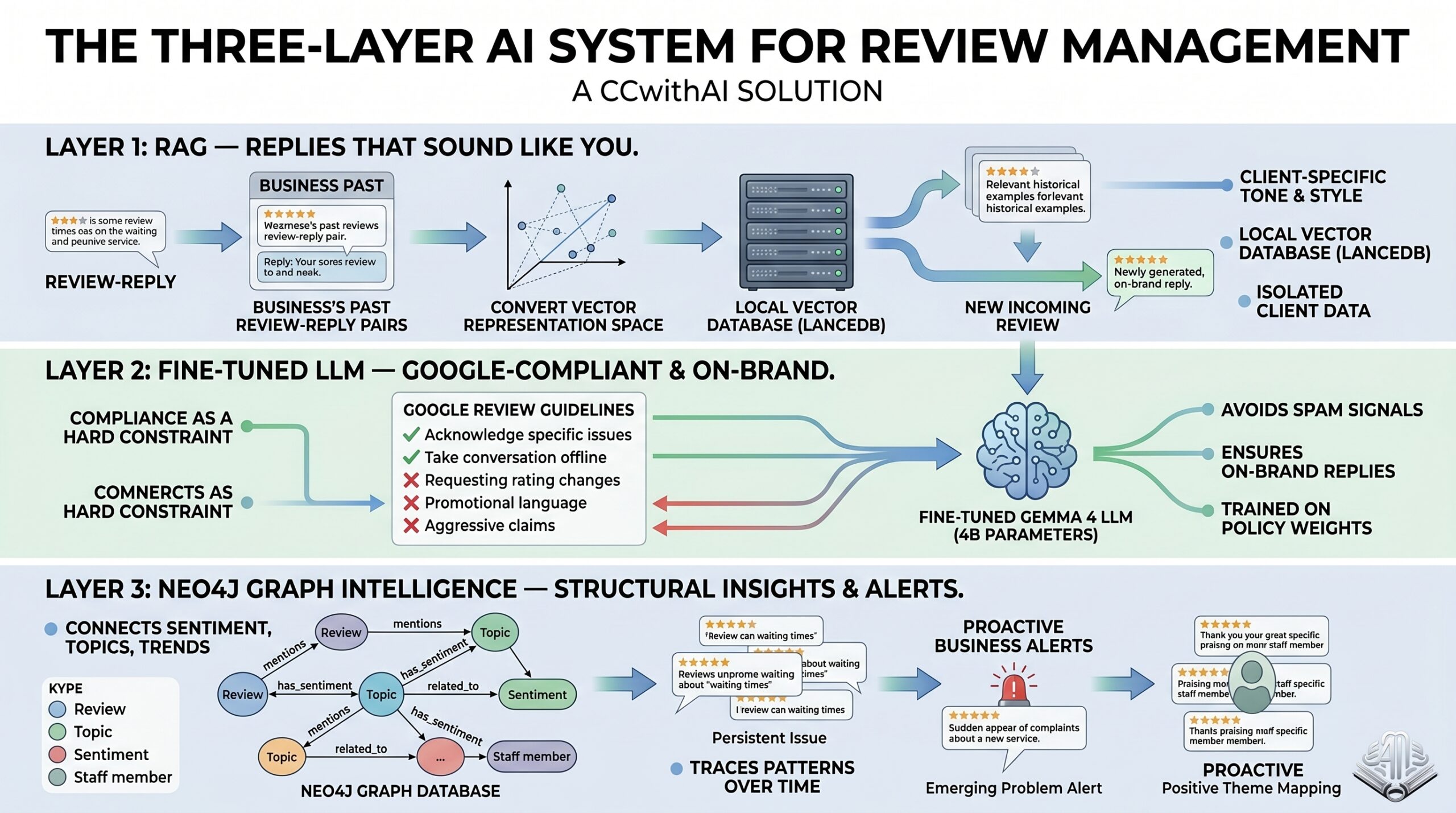
    Layer 1: RAG — Replies That Sound Like You

    The foundation of the system is Retrieval-Augmented Generation (RAG). The core idea: instead of asking AI to “write a professional reply”, the system learns from your own past replies and uses them as the template for everything it generates.

    When you onboard a new client, you feed the system a batch of their historical reviews alongside the actual replies they sent. Each review-reply pair gets converted into a vector embedding — a mathematical representation of its meaning and tone — and stored in a local vector database (LanceDB).

    When a new review comes in, the system finds the most similar past reviews from that client’s history and retrieves how they actually replied at the time. These become live examples — few-shot context that tells the AI: “here’s a complaint about a delayed job, and here’s exactly how this client handled it before.” The generated reply follows the same structure, tone, warmth, and register.

    The result is a response that sounds like it came from the same person who’s always managed this client’s reviews — because the AI is literally modelling that person’s writing style from real examples.

    Data isolation is strict. Each client’s history is completely separated. A bathroom fitter’s tone doesn’t bleed into a car dealership’s replies. Each profile also holds persistent global instructions — things like “always sign off with ‘The GS Bathroom Team’” or “never mention prices in a public reply” — that are baked into every generation.

    Layer 2: A Fine-Tuned LLM Trained on Google’s Review Guidelines

    Here’s where it gets more interesting — and where this system diverges from anything you’d get from a generic AI tool.

    We fine-tuned a 4-billion parameter language model (based on Gemma 4) specifically on Google’s guidelines for what can and cannot be included in a review reply.

    Why does this matter? Because Google has a clear set of rules around review responses, and violating them — even unintentionally — can get your reply removed, flag your listing, or damage your ranking. Generic AI doesn’t know these rules in any reliable way. It will sometimes get them right, sometimes get them wrong, and it has no way to tell the difference.

    Our fine-tuned model has been trained to treat compliance as a hard constraint, not a soft guideline. It has learned:

    • What’s not allowed: asking reviewers to change their rating in a reply, disclosing personal information about the customer, using promotional language like discount offers, aggressive counter-claims, or anything that could be flagged as harassment
    • What’s strongly discouraged: overly templated language that triggers spam signals, replies that don’t address the specific review, keyword-stuffing in replies
    • What works: acknowledging the specific issue raised, keeping negative replies brief and taking the conversation offline, thanking reviewers by first name when possible, responses that match the emotional register of the review

    The practical result: every reply the system generates is not just on-brand — it’s compliant. You’re not gambling on whether the AI happens to know Google’s policies this week. Compliance is baked into the model weights.

    This is particularly valuable for agencies managing review responses across multiple clients, where one badly-worded AI reply could create a problem that takes weeks to resolve.

    Layer 3: Neo4j Graph Intelligence — Turning Reviews Into Business Insight

    The third layer is where the system moves beyond reply generation and starts doing something genuinely new.

    Alongside the vector database, all reviews and their metadata — sentiment, topic, date, location (where relevant), recurring themes — are stored in a Neo4j graph database. In a graph database, data isn’t just stored in rows and tables. It’s stored as a web of relationships. Entities connect to each other: a review connects to a topic, a topic connects to a time period, a time period connects to a pattern, a pattern connects to an alert.

    This structure lets the system do something a standard vector search can’t: it can trace patterns across reviews over time and surface insights about the business itself.

    Some of what this enables:

    Persistent issue detection. If a plumbing business has received 11 reviews over six months that mention waiting times, the graph will surface this as a persistent theme — even if individual reviews used different language (“took ages”, “had to wait weeks”, “appointment kept being pushed back”). A vector search finds similar reviews. A graph finds relationships between them and tells you how long this has been a problem.

    Emerging problem alerts. When a new complaint topic appears more than twice in a short window — a new staff member generating friction, a supplier change affecting product quality, a seasonal service issue — the graph spots it as a cluster and flags it before it becomes a pattern. You find out about it from your own data before it shows up as a dip in your star rating.

    Positive theme mapping. The same logic applies to praise. If customers keep mentioning a specific team member by name, a particular part of the service, or a detail of the experience, the graph maps these as strengths. This feeds back into how the business operates — and how it markets itself.

    Relationship context for generation. When the RAG layer retrieves similar past reviews, the graph layer adds context: “this is the third complaint about this issue this quarter.” The reply can acknowledge the pattern appropriately, rather than treating each review as an isolated event.

    The cumulative effect is that a business using this system isn’t just managing reviews more efficiently — it’s generating a continuous stream of structured business intelligence from what is normally an unstructured, ignored data source.

    Why Local-First

    The entire system runs on your machine using local LLM inference via LM Studio. Nothing is sent to an external API. No review text, no customer names, no complaint details leave your premises.

    This matters more than it might seem. Customer reviews often contain sensitive specifics — service dates, personal complaints, staff names, location details. The moment that data enters a third-party API, you’ve lost control of it. Running locally means the privacy boundary stays exactly where it should: with you.

    It also means no per-query API costs, no rate limits on generation, and no dependency on an internet connection to produce replies.

    What Day-to-Day Use Looks Like

    For a business receiving 20–40 reviews a week, the workflow is simple:

    1. Open the interface, select the client
    2. Paste the new review
    3. Receive a ready-to-use reply in a few seconds
    4. Review, optionally edit, post

    What would previously take 90 minutes of thinking, drafting, and quality-checking across multiple platforms takes under 20 minutes — and the output is consistently on-brand and compliant.

    For agencies managing review responses across multiple clients, the compound time saving is significant. More importantly, the quality floor is raised: no rushed replies written at 11pm, no generic filler that makes the business look like it doesn’t care, and no accidental policy violations that create more work down the line.

    The graph intelligence layer surfaces as a regular report — weekly or monthly, depending on review volume — showing emerging patterns, persistent issues, and positive themes that the business can actually act on.

    The Bigger Picture

    What we’ve built here is a working example of how a small but well-designed AI system — one trained on the right data, built around the right architecture, and given access to the right relationships — can do something genuinely useful that a generic AI assistant cannot.

    The fine-tuned model knows Google’s policies not because we told it to check them, but because that knowledge is part of its weights. The graph database finds patterns not because we wrote rules to look for them, but because relationships between data points emerge naturally and can be queried. The RAG layer matches tone not because we described the brand, but because it learned from the brand’s own history.

    Each layer does something the others can’t. Together, they produce a system that turns one of the most time-consuming and undervalued tasks in local business management into a source of both efficiency and insight.

    If you’re managing reviews across multiple locations or clients and the process feels like it’s always slipping down the priority list, this is worth a conversation.

    Interested?

    We’re happy to walk you through a live demo — either for your own business or as a white-label tool for your agency.

    Contact us at info@ccwithai.com or visit ccwithai.com.

    CCwithAI is a Manchester-based AI automation and application development agency. We build practical AI tools for UK businesses — systems that solve real problems using the right architecture, not the most obvious one.

  • We Trained an AI to Investigate Missing Parcels — Here’s What We Learned

    We Trained an AI to Investigate Missing Parcels — Here’s What We Learned

    Case Study — AI Model Training

    We Trained a Custom AI Model to Investigate Missing Parcels — Here’s Exactly How We Did It

    A major UK retailer was haemorrhaging time and money manually reviewing courier photos. We built them a fine-tuned vision model that makes the call in seconds. This is the full story.

    The Problem Nobody Talks About

    Missing parcel claims are one of the most expensive and time-consuming operational problems in e-commerce. Every day, logistics teams sift through hundreds — sometimes thousands — of courier delivery photos trying to answer a single question: did this delivery actually happen properly, or not?

    The client who came to us was dealing with exactly this. A high-volume retail operation with a dedicated investigations team spending the bulk of their working day reviewing photos from multiple courier partners. Each image had to be assessed manually, cross-referenced with the claim, and categorised. The process was slow, inconsistent across team members, and frankly — unsustainable at scale.

    They’d looked at off-the-shelf computer vision tools. Nothing came close to handling the variability of real delivery photography. Dark doorsteps. Blurry dashcam screenshots. Parcels obscured by wheelie bins. A generic model would fail immediately.

    They needed something trained specifically for their problem.

    “A standard image classification model trained on generic data wasn’t going to cut it. We needed a model that understood the difference between a compliant delivery and a non-compliant one — in the context of real, messy, real-world courier photos.”

    Why This Couldn’t Be Solved With Prompting Alone

    Before going anywhere near model training, we tested the obvious cheaper routes. Could a multimodal foundation model — given a detailed prompt — reliably classify these images? We ran extensive tests. The results were inconsistent. On clear, well-lit photos it performed reasonably well. On the ambiguous cases — which are the ones that actually matter — it struggled.

    The problem isn’t intelligence. It’s specificity. Foundation models are generalists. They haven’t seen thousands of examples of what this courier’s non-compliant delivery looks like, in this client’s context, under these policy rules. That knowledge has to be built in through training data.

    Fine-tuning was the right call. We moved forward.

    Step 1 — Defining What “Compliant” Actually Means

    This was the hardest part of the entire project. Before a single line of training code ran, we sat down with the client’s investigations team for a series of working sessions. The goal: produce an unambiguous labelling guide that any human — or model — could apply consistently.

    It sounds simple. It isn’t. Consider these real edge cases we had to resolve:

    • Parcel placed in a communal corridor, door not visible — compliant or not?
    • Photo taken from inside a vehicle showing a doorstep from distance — acceptable proof?
    • Image shows a “safe place” note visible but no parcel — does the note count?
    • Multiple parcels visible — how do you confirm which one is the claimed item?
    • Photo is clearly timestamped but location data doesn’t match the delivery address

    Every one of these had to be defined, agreed, and documented. The labelling guide became the foundation of the entire system. Without it, you get garbage training data. And garbage training data gives you a garbage model — regardless of how sophisticated the architecture is.

    Step 2 — Building the Training Dataset

    With the labelling guide agreed, we worked through the client’s historical image archive. Thousands of delivery photos, spanning multiple courier partners and conditions. Each image was labelled against our three output categories.

    Data quality checks ran throughout. Ambiguous images — where even experienced team members disagreed — were flagged and either resolved in committee or excluded. We weren’t going to let edge-case noise degrade the model’s confidence on the clear-cut majority.

    We also deliberately balanced the dataset. Real delivery photo archives skew heavily compliant — most deliveries are fine. An unbalanced dataset produces a model that’s great at confirming compliant deliveries and terrible at catching the non-compliant ones, which is precisely the wrong failure mode. We adjusted for this.

    3 Output classifications
    Multi-courier Training data sources
    Balanced Dataset distribution
    Weeks From brief to deployment

    Step 3 — Fine-Tuning the Vision Model

    We fine-tuned a vision model on the labelled dataset — training it to recognise the visual patterns associated with each outcome. The architecture decision was driven by the real-world constraints: the model needed to run fast enough to process claims in near real-time, at scale, without requiring expensive inference infrastructure.

    Training iterations revealed where the model was uncertain. We used those uncertainty signals to go back to the dataset, pull the relevant images, and tighten the labelling. Multiple rounds of this loop produced a model that was genuinely confident on the cases it should be confident on — and genuinely uncertain on the ones that warranted human review.

    That second point is critical and often overlooked. A model that’s confidently wrong is far more dangerous than one that admits uncertainty. We optimised specifically for well-calibrated confidence, not just raw accuracy on the test set.

    What the Model Returns

    When a missing parcel claim arrives, the system pulls the associated delivery photo and runs it through the model. The response comes back in seconds with one of three outcomes:

    ✓ Compliant

    Evidence of a valid delivery attempt is present. The claim is likely fraudulent or the result of a genuine mistake. Flag for follow-up with the customer.

    ✗ Non-Compliant

    Delivery issue confirmed. The courier failed to meet the required standard. Claim is warranted — escalate to courier partner for resolution.

    ⚠ Refer

    Image is ambiguous or falls outside the model’s confident range. Send to a human investigator with the model’s reasoning attached.

    The Refer category is not a weakness. It’s a feature. A system that knows its own limits — and routes edge cases to humans rather than making a confident wrong call — is a production-ready system. The goal was never to remove humans entirely. It was to make humans only deal with the cases that genuinely need them.

    The Business Impact

    The investigations team went from reviewing every incoming claim manually to only handling the Refer category. The vast majority of claims — the clear-cut compliant and non-compliant ones — are now processed automatically, in seconds, with a documented audit trail attached.

    • First-pass investigation time dramatically reduced
    • Fraudulent claims caught that were previously settled to avoid admin overhead
    • Consistent decisions — no more variation between team members
    • Full audit trail on every classification for compliance and dispute purposes
    • The system scales with claim volume — no additional headcount required

    What This Actually Demonstrates

    You do not need to be Google, Amazon, or a university research lab to train a production AI model. You need three things: a clearly defined problem, a well-labelled dataset, and people who understand how to build the system properly.

    CCwithAI is a Manchester-based AI development company. We don’t resell access to ChatGPT with a markup. We don’t bolt AI wrappers onto existing software and call it innovation. We build custom AI systems — trained, fine-tuned, and deployed for specific business problems — for companies that need something that actually works.

    This parcel investigation system is one example. The same approach applies to any business process that involves repetitive decision-making on visual, textual, or structured data. Quality control. Document classification. Customer intent detection. Compliance checking. If humans are doing it repeatedly by following a consistent set of rules — a model can be trained to do it faster, cheaper, and at scale.

    Got a Problem That Needs a Real AI Solution?

    Not a chatbot. Not a prompt wrapper. A system built specifically for your business.

    We’ll tell you honestly whether AI is the right tool — and if it is, we’ll build it properly.

    Book a Free Consultation
  • Opus 4.7 Just Landed

    Opus 4.7 Just Landed

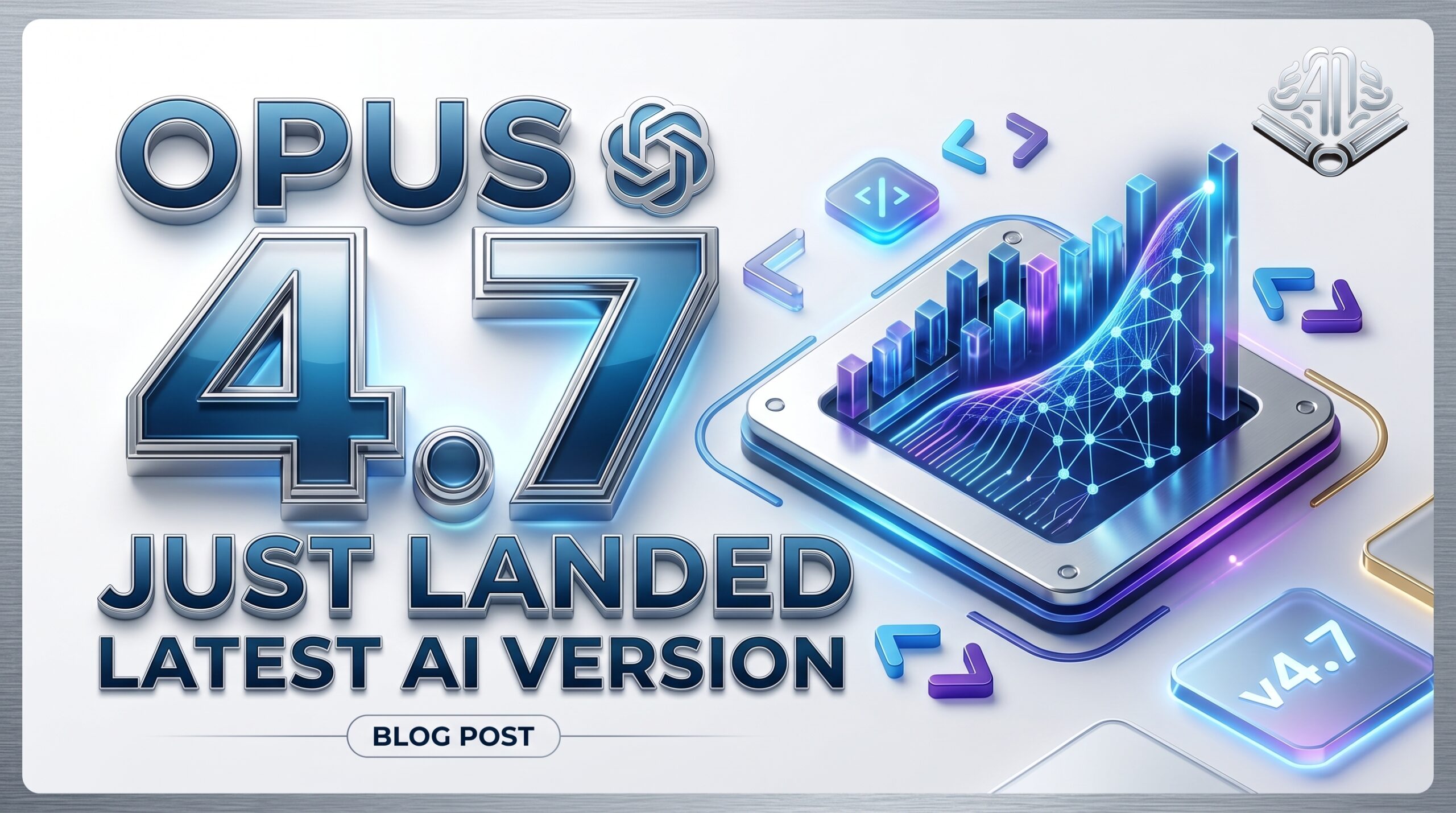
    Anthropic Launches Claude Opus 4.7: A New Benchmark for Agentic AI and Coding

    Explore the capabilities of the AI Opus 4.7 Latest release, setting new standards for reasoning and automation.

    Explore AI Automation Services

    On 16 April 2026, Anthropic released AI Opus 4.7 Latest, the most recent iteration of its flagship model. Arriving two months after the release of Opus 4.6, this update delivers measurable improvements in reasoning, vision, and operational reliability.

    Key Differentiators in AI Opus 4.7 Latest

    Early adopters have identified several areas where the AI Opus 4.7 Latest release moves beyond incremental updates to fundamentally change model operation.

    • Coding and Software Engineering: Sustains effort over long-running tasks within large, complex codebases.
    • Advanced Vision: Processes images up to 2,576 pixels, allowing agents to navigate dense UIs.
    • Self-Verification: Audits outputs before finalising to reduce hallucinations.

    Performance Metrics

    BenchmarkOpus 4.6Opus 4.7
    SWE-bench Pro53.4%64.3%
    Vision Accuracy54.5%98.5%
    CursorBench58%70%

    Impact Assessment for Enterprise

    The deployment of the AI Opus 4.7 Latest has significant implications for businesses looking to scale. By delegating complex tasks—such as data extraction or code maintenance—to this model, organisations can drastically improve operational efficiency.

    Frequently Asked Questions

    What is AI Opus 4.7 Latest?

    AI Opus 4.7 Latest is Anthropic’s most recent generally available AI model, specifically engineered to handle advanced coding tasks and complex agentic workflows.

    How does it compare to competitors?

    Opus 4.7 currently leads the market in agentic coding and scaled tool-use, consistently outperforming models like GPT-5.4 and Gemini 3.1 Pro in key industry benchmarks.

  • How to Optimize Your Website for Generative Search (GEO)

    How to Optimize Your Website for Generative Search (GEO)

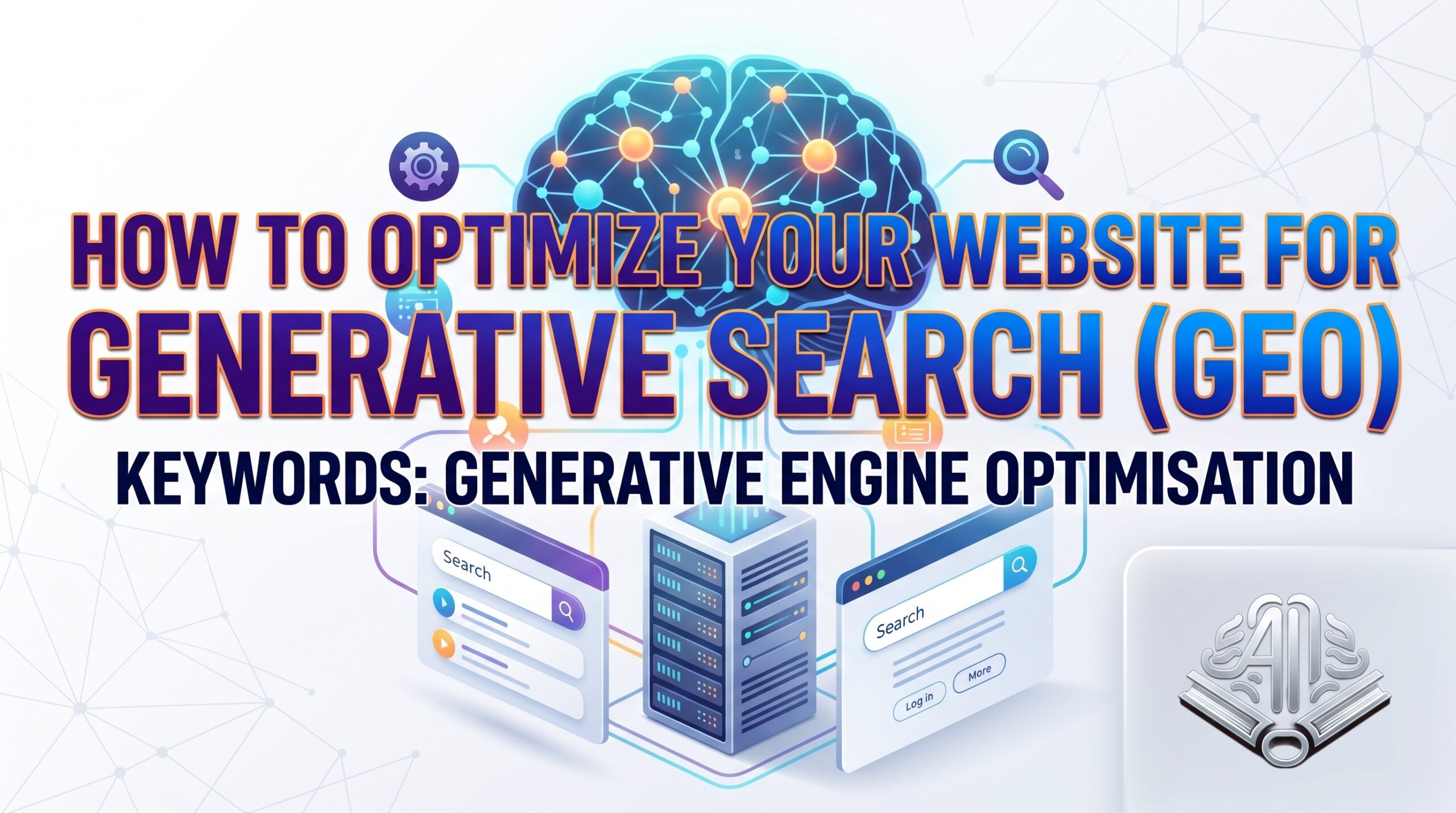
    Generative Engine Optimisation (GEO): A Guide for 2026 and Beyond

    Master the shift from traditional search to AI-driven discovery and ensure your brand remains visible.

    Start Your GEO Strategy

    The way people use search engines is changing faster than at any point since their inception. We are moving away from the “ten blue links” era and into the age of the Generative Engine, where AI provides direct, synthesized answers. For business owners and marketers, this profound shift requires a fundamental change in strategy: moving from traditional Search Engine Optimisation (SEO) to Generative Engine Optimisation (GEO). Ignoring this evolution means risking invisibility in the new digital landscape.

    Understanding Generative AI and Search

    To prepare for the future, it helps to understand the technology behind it. Generative AI models, powered by Large Language Models (LLMs), interpret not just keywords, but the full context, intent, and complex relationships between concepts. This transforms search engines from mere “information retrieval” tools into sophisticated “answer engines” that synthesize information from multiple sources to provide a concise, direct response. This means your content isn’t just competing for a click; it’s competing to be the authoritative source cited within an AI-generated summary.

    The Shift in User Behaviour: The Rise of Zero-Click Searches

    Users are increasingly relying on AI summaries to save time, often finding their answers directly within the search results page without needing to click through to a website. This phenomenon, known as “zero-click search,” is becoming the norm. If your website is not structured and optimised to be identified as a credible “entity” by the AI, providing clear, concise, and authoritative answers, you will remain invisible, regardless of your traditional keyword rankings. AI prioritizes content that directly addresses user queries with high confidence and verifiable facts.

    The Core Principles of GEO

    While traditional SEO focused heavily on keyword density, backlinks, and technical crawlability, GEO demands a more holistic approach centered on clarity, structure, and undeniable authority. The foundational principle of E-E-A-T (Experience, Expertise, Authoritativeness, and Trustworthiness) becomes even more critical in an AI-driven world.

    • Semantic SEO: Beyond Keywords to Concepts
      Instead of merely targeting specific keywords, Semantic SEO focuses on the underlying meaning and intent behind a query. This involves creating comprehensive content that covers entire topics and subtopics, building “topic clusters” that demonstrate deep knowledge. AI models understand natural language and the relationships between ideas, making content that addresses a user’s broader informational need far more valuable than content stuffed with isolated keywords.
    • Entity SEO: Defining Your Digital Identity
      Entity SEO is about establishing your brand, products, services, or even key personnel as distinct, verifiable “entities” in the eyes of AI. This means ensuring consistent Name, Address, Phone (NAP) data across all platforms, building a robust Google Business Profile, and actively contributing to your brand’s knowledge graph. When AI can confidently identify your brand as a recognized entity, it’s more likely to cite your information as authoritative.
    • Structured Data: A Roadmap for AI Models
      Structured data, particularly using JSON-LD, provides explicit signals to AI models about the content on your page. It’s like giving the AI a detailed map of your website’s information. Implementing schema markup for `Article`, `Product`, `FAQPage`, `HowTo`, `LocalBusiness`, and `Review` types helps AI understand the context, relationships, and specific attributes of your content, significantly increasing the chances of your information being accurately extracted and presented in AI overviews.
    • E-E-A-T (Experience, Expertise, Authoritativeness, Trustworthiness): The AI’s Quality Filter
      In an age of abundant information, AI relies heavily on E-E-A-T to determine content quality and reliability. To demonstrate E-E-A-T, focus on showcasing author credentials, citing reputable sources, building a strong backlink profile from authoritative sites, accumulating positive user reviews, and maintaining a secure and user-friendly website. AI is designed to prioritize information from trusted, experienced sources.

    Implementing a GEO Strategy: Actionable Steps

    To significantly increase your chances of being cited in an AI Overview and driving qualified traffic, your content strategy must evolve. Focus on these key areas:

    • Targeting Long-Tail, Conversational Queries: AI interactions are often conversational. Optimise for natural language questions (e.g., “What is the best web design agency in Manchester for small businesses?”) rather than short, fragmented keywords. Tools like “People Also Ask” sections and forum analysis can reveal these valuable queries.
    • Structuring Content with Clear H2s and H3s: Use a logical hierarchy of headings to break down complex topics into digestible sections. This not only improves readability for human users but also helps AI models quickly identify and extract key information and answers to specific questions.
    • Using Lists and Tables for Efficient AI Processing: AI excels at processing structured data. Presenting information in bulleted lists (for features or benefits), numbered lists (for steps or processes), and tables (for comparisons or data sets) makes it incredibly easy for AI to synthesize and present your content concisely.
    • Ensuring Image and Video Assets Include Descriptive Metadata: AI is becoming increasingly multimodal. Provide comprehensive `alt` text for images, detailed captions, and full transcripts for videos. Use structured data for `ImageObject` and `VideoObject` to give AI explicit context about your visual and auditory content, making it discoverable across different search modalities.
    • Creating AI-Friendly Content: Write with clarity, conciseness, and directness. Avoid jargon where possible and get straight to the point. AI prioritizes content that provides definitive answers without excessive fluff. Think of your content as a direct response to a user’s question.
    • Optimising for Voice Search: As voice assistants become more prevalent, optimising for spoken queries is crucial. This often overlaps with long-tail, conversational query optimisation, focusing on natural language patterns and direct answers.
    • Building a Strong Internal Linking Structure: A well-organised internal link profile helps AI understand the relationships between different pieces of content on your site, reinforcing your site’s authority on a given topic.

    GEO for Local Businesses: Dominating Your Local Market

    For businesses operating in competitive local markets like Manchester, GEO is not just an advantage; it’s a powerful necessity for local visibility. AI models are increasingly sophisticated at understanding local intent and delivering hyper-relevant results. By leveraging specific GEO tactics, you can ensure your business stands out:

    • Comprehensive Google Business Profile (GBP): Maintain a meticulously complete and regularly updated GBP. Include accurate business hours, services, photos, and respond promptly to all reviews. GBP is a primary data source for local AI queries.
    • LocalBusiness Schema Markup: Implement `LocalBusiness` schema with specific properties like `address`, `telephone`, `openingHours`, `hasMap`, `geo`, and `review`. This explicitly tells AI models your business’s location and key details.
    • Consistent Local Citations: Ensure your NAP (Name, Address, Phone) information is consistent across all online directories (Yelp, Yellow Pages, industry-specific sites). Inconsistencies confuse AI and erode trust.
    • Localised Content Strategy: Create content that speaks directly to your local audience. Blog posts about local events, services tailored to specific Manchester neighborhoods, or case studies featuring local clients can significantly boost local relevance signals for AI.
    • Encouraging Local Reviews: Positive reviews on Google and other platforms are a strong signal of trustworthiness and customer satisfaction for AI. Actively encourage satisfied customers to leave reviews.

    Case Study: Local Dominance in Manchester

    CCwithAI.com recently helped a Manchester agency restructure their service pages to include entity-specific schema, comprehensive local content, and a refined Google Business Profile strategy. Within three months, the business saw a 25% increase in visibility within AI-generated summaries for “web design services Manchester” and a 15% uplift in local organic traffic, demonstrating the tangible impact of a well-executed GEO strategy.

    View Our Web Design Services

    Conclusion: Embrace GEO, Secure Your Future

    Generative Engine Optimisation is not a fleeting trend; it is the new reality of digital discovery. The shift from traditional search to AI-driven answers demands a proactive and intelligent approach to your online presence. At CCwithAI.com, we specialise in bridging the gap between cutting-edge AI technology and practical business growth. We understand the nuances of this evolving landscape and are equipped to help you adapt.

    Whether you are a local business in Manchester striving for community dominance or a national brand aiming for broad AI visibility, we are here to help you navigate the complexities of Generative Engine Optimisation, ensuring your brand remains authoritative, discoverable, and successful in 2026 and beyond.

    Contact Us Today to Future-Proof Your Business
  • How We Helped a Major On-line Retailer

    How We Helped a Major On-line Retailer

    Manchester’s CCwithAI Automates Online Retail Logistics for Missing Parcel Investigations (MPD)

    Transforming online retail efficiency with agentic AI. Resolve lost parcel claims across all carriers in minutes, not days.

    Get Started with AI Automation

    The “Missing Parcel” Problem in UK Online Retail

    The landscape of UK online retail logistics is undergoing a significant transformation, with the escalating challenge of missing parcels demanding innovative solutions. As a Manchester-based consultancy, CCwithAI – AI for Retail – Missing Parcel Investigations (MPD), a pioneering Independent Expert AI consultancy, we are leading this charge. We’ve successfully deployed an advanced automated solution for a prominent blue-chip UK online retailer, showcasing a powerful case study in operational excellence. This groundbreaking system, leveraging custom Large Language Models (LLMs) and agentic AI, completely replaces manual claims handling. It resolves “missing parcel” issues across all delivery services in minutes, achieving an industry-leading error rate of less than 0.4%.

    UK online retailers lose an estimated £2.1 billion annually due to unclaimed courier refunds. With 1.7 million packages going missing or being stolen daily, the need to automate loss prevention is urgent. Our solution directly addresses these pain points, significantly reducing financial losses and operational overhead.

    How the CCwithAI Solution Works

    Our implementation moves beyond standard chatbots. It utilises “Agentic AI,” which plans, executes, and iterates tasks autonomously, delivering unparalleled accuracy and efficiency.

    End-to-End Automation

    The AI manages the entire lifecycle of an MPD claim from submission to resolution, drastically reducing manual effort and driving down operational costs by automating up to 95% of claims.

    Intelligent Verification

    Integrates with mapping APIs and photographic evidence to independently verify delivery attempts.

    Fraud Detection

    Deploys advanced, multi-layered fraud detection algorithms, analyzing consumer behavior, historical data, and delivery patterns to proactively identify and prevent potential return fraud, chargeback fraud, and other deceptive practices, protecting significant profit margins and reducing fraudulent claims by over 80%.

    Global Compliance & Connectivity

    The system is context-aware, adheres strictly to individual retailer guidelines, and possesses the capability to communicate and integrate with virtually any delivery company worldwide, ensuring global applicability and seamless operations.

    Impact Assessment: Who Benefits?

    For the Business

    • Operational Efficiency: Drastically reduces human agent hours, driving down operational costs by up to 70%.
    • Unmatched Accuracy: Achieves an industry-leading error rate of less than 0.4% in claim resolution, minimizing costly re-investigations.
    • Financial Recovery: Maximizes reclaiming lost courier refunds.
    • Fraud Mitigation: Robust protection against fraudulent claims, safeguarding profit margins.
    Explore Our Services

    For the Consumer

    • Speed of Resolution: Near real-time claim processing.
    • Transparency: 24/7 automated status updates.
    • Personalisation: Tailored support experiences.
    Read Our Insights

    Ready to Automate Your Retail Logistics?

    Book a free consultation with our super smart AI chatbot on the CCwithAI website to discover how we can transform your operations.

    Book Your Free AI Consultation

    Frequently Asked Questions

    How can AI help track missing packages?

    AI can analyse drop-off photos and cross-reference them with GPS data to identify theft or misplacement, significantly speeding up our Missing Parcel Investigations (MPD).

    What is the difference between Generative and Agentic AI?

    Generative AI creates content; Agentic AI is designed to act, autonomously executing complex operational tasks without constant human intervention.

  • Latest AI News Brief

    Latest AI News Brief

    From Experimentation to Execution: How AI News is Reshaping Retail in 2026

    The retail sector has moved past the experimental phase. Staying updated with the latest AI news is no longer optional—it is the core infrastructure for modern commerce.

    Explore Our AI Solutions

    A New Era: April 2026 AI News and Developments

    The first week of April 2026 underscored the rapid pace of change across the retail landscape. From strategic executive appointments to groundbreaking in-store deployments, the industry is unequivocally embracing AI as its operational backbone. As industry leaders pivot toward agentic systems, the demand for actionable intelligence has never been higher.

    Key Industry Updates

    • April 2, 2026: Home Depot appoints new CTO to spearhead agentic AI strategy. The retail giant signals a major investment in autonomous systems, aiming to optimize everything from inventory management to customer service workflows.
    • April 2, 2026: Loop Neighborhood Markets deploys “Genie,” an autonomous AI store associate. This pilot program in select California locations aims to handle routine customer inquiries, stock checks, and even assist with checkout, freeing human staff for more complex tasks.
    • April 4, 2026: BMW of Bridgewater integrates in-house voice agents to bridge BDC staffing gaps. The luxury dealership reports a 20% increase in lead qualification efficiency and improved customer satisfaction through 24/7 AI-powered engagement.
    • April 5, 2026: Amazon announces new AI-powered predictive logistics platform. Designed to anticipate demand fluctuations with unprecedented accuracy, the system promises to reduce delivery times and minimize waste across its vast supply chain.

    The Shift to Agentic AI in Retail

    We have moved beyond simple generative marketing copy into the age of Agentic AI. Unlike standard models, these systems plan, execute, and iterate autonomously, from inventory rebalancing to demand forecasting.

    This evolution marks a significant departure from previous AI iterations. While generative AI excels at content creation and basic automation, agentic AI systems are designed to operate with a higher degree of autonomy. They can perceive their environment, set goals, plan actions, execute those actions, and learn from the outcomes, much like a human agent. This capability allows them to manage complex, multi-step processes without constant human oversight, fundamentally transforming operational efficiency.

    Imagine an agentic AI system monitoring real-time sales data, identifying a sudden surge in demand for a specific product, automatically reordering stock from the most efficient supplier, adjusting dynamic pricing, and even initiating targeted marketing campaigns – all without human intervention beyond initial setup and oversight.

    Read Our Latest Insights

    Deep Dive: AI in Supply Chain & Logistics

    AI’s impact on the retail supply chain is revolutionary. From predictive analytics that forecast demand with unparalleled accuracy to autonomous robotics in warehouses and route optimization algorithms, AI is creating leaner, more resilient, and more responsive supply networks. This translates to reduced waste, faster delivery times, and ultimately, happier customers.

    Companies like Walmart are leveraging AI to manage their vast inventory, predicting which items will sell out and ensuring shelves are always stocked, while simultaneously optimizing delivery routes for their fleet, cutting fuel costs and emissions.

    Market Outlook and Future Trends

    The Growth Trajectory

    The global AI in retail market is projected to reach over USD 130 billion by 2033, driven by increasing consumer expectations for personalized experiences and retailers’ urgent need for operational efficiencies. With 40% of enterprise applications expected to include task-specific agents by the end of 2026, the competitive landscape is shifting rapidly, rewarding early adopters with significant market advantages.

    Strategic Priorities

    • AI Optimisation vs. SEO
    • Regulatory Compliance
    • Human-in-the-loop Assistants
    • Full-scale Agentic Deployment

    Emerging Challenges

    • Data Privacy & Security
    • Ethical AI Deployment
    • Integration Complexity
    • Workforce Adaptation

    The Human Element: Reskilling and Collaboration

    While AI automates many routine tasks, it also elevates the role of human employees. Retailers are investing heavily in reskilling programs, training staff to work alongside AI, manage agentic systems, and focus on higher-value tasks that require creativity, empathy, and complex problem-solving. The future of retail is not about replacing humans with AI, but augmenting human capabilities with intelligent automation.

    Expert Commentary

    “The rapid deployment of agentic AI in retail necessitates a strong focus on ethical guidelines and transparency. Ensuring these systems are fair, accountable, and privacy-preserving will be crucial for consumer trust and long-term success.”

    — Dr. Anya Sharma, Leading AI Ethicist

    Frequently Asked Questions

    How do retailers use AI today?

    Retailers leverage AI for hyper-personalisation, dynamic pricing, fraud detection, and seamless omnichannel engagement.

    What is the difference between Generative and Agentic AI?

    Generative AI creates content; Agentic AI autonomously executes complex operational tasks without constant human intervention.

    What are the ethical considerations for AI in retail?

    Ethical considerations include data privacy, algorithmic bias in pricing or recommendations, job displacement concerns, and the need for transparency in AI decision-making.

    Ready to Future-Proof Your Business?

    Don’t just follow the AI news—lead your industry with custom AI automation.

    Book a Consultation