Blog

  • We Built a Three-Layer AI System That Replies to Reviews, Stays Google-Compliant, and Spots Problems Before They Become Crises

    We Built a Three-Layer AI System That Replies to Reviews, Stays Google-Compliant, and Spots Problems Before They Become Crises

    Most businesses treat customer reviews as a chore. Reply to the good ones, apologise for the bad ones, move on. The replies are rarely strategic, often generic, and — if you’re using off-the-shelf AI — frequently sound like they were written by the same robot replying to every business in the country.

    We built something substantially different. What started as a solution to a simple problem — helping our clients reply to reviews faster without losing their brand voice — evolved into a three-layer AI system that does things no generic tool can do.

    Here’s what we built, how it works, and why it matters.

    The Three Layers

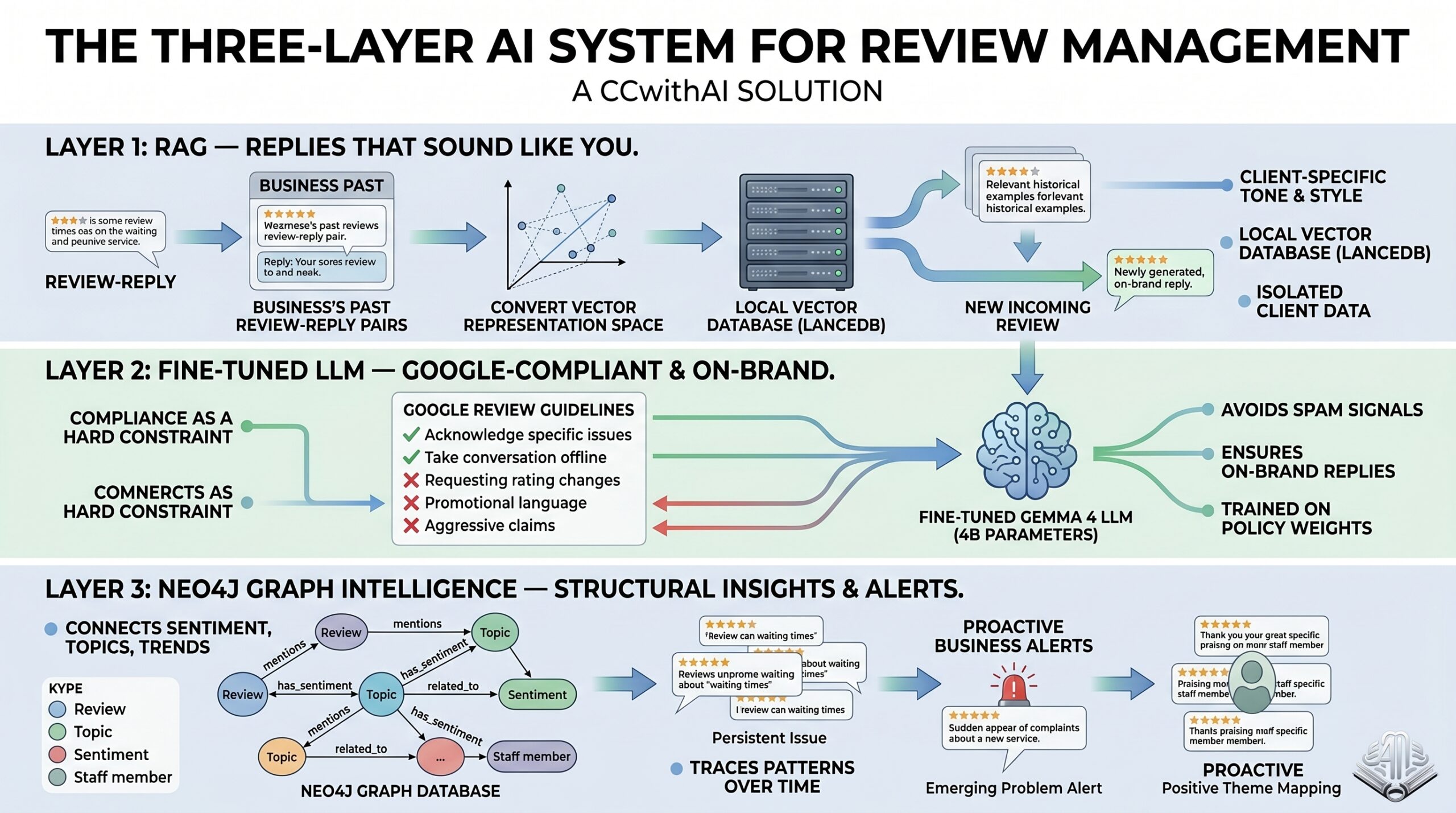
    Layer 1: RAG — Replies That Sound Like You

    The foundation of the system is Retrieval-Augmented Generation (RAG). The core idea: instead of asking AI to “write a professional reply”, the system learns from your own past replies and uses them as the template for everything it generates.

    When you onboard a new client, you feed the system a batch of their historical reviews alongside the actual replies they sent. Each review-reply pair gets converted into a vector embedding — a mathematical representation of its meaning and tone — and stored in a local vector database (LanceDB).

    When a new review comes in, the system finds the most similar past reviews from that client’s history and retrieves how they actually replied at the time. These become live examples — few-shot context that tells the AI: “here’s a complaint about a delayed job, and here’s exactly how this client handled it before.” The generated reply follows the same structure, tone, warmth, and register.

    The result is a response that sounds like it came from the same person who’s always managed this client’s reviews — because the AI is literally modelling that person’s writing style from real examples.

    Data isolation is strict. Each client’s history is completely separated. A bathroom fitter’s tone doesn’t bleed into a car dealership’s replies. Each profile also holds persistent global instructions — things like “always sign off with ‘The GS Bathroom Team’” or “never mention prices in a public reply” — that are baked into every generation.

    Layer 2: A Fine-Tuned LLM Trained on Google’s Review Guidelines

    Here’s where it gets more interesting — and where this system diverges from anything you’d get from a generic AI tool.

    We fine-tuned a 4-billion parameter language model (based on Gemma 4) specifically on Google’s guidelines for what can and cannot be included in a review reply.

    Why does this matter? Because Google has a clear set of rules around review responses, and violating them — even unintentionally — can get your reply removed, flag your listing, or damage your ranking. Generic AI doesn’t know these rules in any reliable way. It will sometimes get them right, sometimes get them wrong, and it has no way to tell the difference.

    Our fine-tuned model has been trained to treat compliance as a hard constraint, not a soft guideline. It has learned:

    • What’s not allowed: asking reviewers to change their rating in a reply, disclosing personal information about the customer, using promotional language like discount offers, aggressive counter-claims, or anything that could be flagged as harassment
    • What’s strongly discouraged: overly templated language that triggers spam signals, replies that don’t address the specific review, keyword-stuffing in replies
    • What works: acknowledging the specific issue raised, keeping negative replies brief and taking the conversation offline, thanking reviewers by first name when possible, responses that match the emotional register of the review

    The practical result: every reply the system generates is not just on-brand — it’s compliant. You’re not gambling on whether the AI happens to know Google’s policies this week. Compliance is baked into the model weights.

    This is particularly valuable for agencies managing review responses across multiple clients, where one badly-worded AI reply could create a problem that takes weeks to resolve.

    Layer 3: Neo4j Graph Intelligence — Turning Reviews Into Business Insight

    The third layer is where the system moves beyond reply generation and starts doing something genuinely new.

    Alongside the vector database, all reviews and their metadata — sentiment, topic, date, location (where relevant), recurring themes — are stored in a Neo4j graph database. In a graph database, data isn’t just stored in rows and tables. It’s stored as a web of relationships. Entities connect to each other: a review connects to a topic, a topic connects to a time period, a time period connects to a pattern, a pattern connects to an alert.

    This structure lets the system do something a standard vector search can’t: it can trace patterns across reviews over time and surface insights about the business itself.

    Some of what this enables:

    Persistent issue detection. If a plumbing business has received 11 reviews over six months that mention waiting times, the graph will surface this as a persistent theme — even if individual reviews used different language (“took ages”, “had to wait weeks”, “appointment kept being pushed back”). A vector search finds similar reviews. A graph finds relationships between them and tells you how long this has been a problem.

    Emerging problem alerts. When a new complaint topic appears more than twice in a short window — a new staff member generating friction, a supplier change affecting product quality, a seasonal service issue — the graph spots it as a cluster and flags it before it becomes a pattern. You find out about it from your own data before it shows up as a dip in your star rating.

    Positive theme mapping. The same logic applies to praise. If customers keep mentioning a specific team member by name, a particular part of the service, or a detail of the experience, the graph maps these as strengths. This feeds back into how the business operates — and how it markets itself.

    Relationship context for generation. When the RAG layer retrieves similar past reviews, the graph layer adds context: “this is the third complaint about this issue this quarter.” The reply can acknowledge the pattern appropriately, rather than treating each review as an isolated event.

    The cumulative effect is that a business using this system isn’t just managing reviews more efficiently — it’s generating a continuous stream of structured business intelligence from what is normally an unstructured, ignored data source.

    Why Local-First

    The entire system runs on your machine using local LLM inference via LM Studio. Nothing is sent to an external API. No review text, no customer names, no complaint details leave your premises.

    This matters more than it might seem. Customer reviews often contain sensitive specifics — service dates, personal complaints, staff names, location details. The moment that data enters a third-party API, you’ve lost control of it. Running locally means the privacy boundary stays exactly where it should: with you.

    It also means no per-query API costs, no rate limits on generation, and no dependency on an internet connection to produce replies.

    What Day-to-Day Use Looks Like

    For a business receiving 20–40 reviews a week, the workflow is simple:

    1. Open the interface, select the client
    2. Paste the new review
    3. Receive a ready-to-use reply in a few seconds
    4. Review, optionally edit, post

    What would previously take 90 minutes of thinking, drafting, and quality-checking across multiple platforms takes under 20 minutes — and the output is consistently on-brand and compliant.

    For agencies managing review responses across multiple clients, the compound time saving is significant. More importantly, the quality floor is raised: no rushed replies written at 11pm, no generic filler that makes the business look like it doesn’t care, and no accidental policy violations that create more work down the line.

    The graph intelligence layer surfaces as a regular report — weekly or monthly, depending on review volume — showing emerging patterns, persistent issues, and positive themes that the business can actually act on.

    The Bigger Picture

    What we’ve built here is a working example of how a small but well-designed AI system — one trained on the right data, built around the right architecture, and given access to the right relationships — can do something genuinely useful that a generic AI assistant cannot.

    The fine-tuned model knows Google’s policies not because we told it to check them, but because that knowledge is part of its weights. The graph database finds patterns not because we wrote rules to look for them, but because relationships between data points emerge naturally and can be queried. The RAG layer matches tone not because we described the brand, but because it learned from the brand’s own history.

    Each layer does something the others can’t. Together, they produce a system that turns one of the most time-consuming and undervalued tasks in local business management into a source of both efficiency and insight.

    If you’re managing reviews across multiple locations or clients and the process feels like it’s always slipping down the priority list, this is worth a conversation.

    Interested?

    We’re happy to walk you through a live demo — either for your own business or as a white-label tool for your agency.

    Contact us at info@ccwithai.com or visit ccwithai.com.

    CCwithAI is a Manchester-based AI automation and application development agency. We build practical AI tools for UK businesses — systems that solve real problems using the right architecture, not the most obvious one.

  • We Trained an AI to Investigate Missing Parcels — Here’s What We Learned

    We Trained an AI to Investigate Missing Parcels — Here’s What We Learned

    Case Study — AI Model Training

    We Trained a Custom AI Model to Investigate Missing Parcels — Here’s Exactly How We Did It

    A major UK retailer was haemorrhaging time and money manually reviewing courier photos. We built them a fine-tuned vision model that makes the call in seconds. This is the full story.

    The Problem Nobody Talks About

    Missing parcel claims are one of the most expensive and time-consuming operational problems in e-commerce. Every day, logistics teams sift through hundreds — sometimes thousands — of courier delivery photos trying to answer a single question: did this delivery actually happen properly, or not?

    The client who came to us was dealing with exactly this. A high-volume retail operation with a dedicated investigations team spending the bulk of their working day reviewing photos from multiple courier partners. Each image had to be assessed manually, cross-referenced with the claim, and categorised. The process was slow, inconsistent across team members, and frankly — unsustainable at scale.

    They’d looked at off-the-shelf computer vision tools. Nothing came close to handling the variability of real delivery photography. Dark doorsteps. Blurry dashcam screenshots. Parcels obscured by wheelie bins. A generic model would fail immediately.

    They needed something trained specifically for their problem.

    “A standard image classification model trained on generic data wasn’t going to cut it. We needed a model that understood the difference between a compliant delivery and a non-compliant one — in the context of real, messy, real-world courier photos.”

    Why This Couldn’t Be Solved With Prompting Alone

    Before going anywhere near model training, we tested the obvious cheaper routes. Could a multimodal foundation model — given a detailed prompt — reliably classify these images? We ran extensive tests. The results were inconsistent. On clear, well-lit photos it performed reasonably well. On the ambiguous cases — which are the ones that actually matter — it struggled.

    The problem isn’t intelligence. It’s specificity. Foundation models are generalists. They haven’t seen thousands of examples of what this courier’s non-compliant delivery looks like, in this client’s context, under these policy rules. That knowledge has to be built in through training data.

    Fine-tuning was the right call. We moved forward.

    Step 1 — Defining What “Compliant” Actually Means

    This was the hardest part of the entire project. Before a single line of training code ran, we sat down with the client’s investigations team for a series of working sessions. The goal: produce an unambiguous labelling guide that any human — or model — could apply consistently.

    It sounds simple. It isn’t. Consider these real edge cases we had to resolve:

    • Parcel placed in a communal corridor, door not visible — compliant or not?
    • Photo taken from inside a vehicle showing a doorstep from distance — acceptable proof?
    • Image shows a “safe place” note visible but no parcel — does the note count?
    • Multiple parcels visible — how do you confirm which one is the claimed item?
    • Photo is clearly timestamped but location data doesn’t match the delivery address

    Every one of these had to be defined, agreed, and documented. The labelling guide became the foundation of the entire system. Without it, you get garbage training data. And garbage training data gives you a garbage model — regardless of how sophisticated the architecture is.

    Step 2 — Building the Training Dataset

    With the labelling guide agreed, we worked through the client’s historical image archive. Thousands of delivery photos, spanning multiple courier partners and conditions. Each image was labelled against our three output categories.

    Data quality checks ran throughout. Ambiguous images — where even experienced team members disagreed — were flagged and either resolved in committee or excluded. We weren’t going to let edge-case noise degrade the model’s confidence on the clear-cut majority.

    We also deliberately balanced the dataset. Real delivery photo archives skew heavily compliant — most deliveries are fine. An unbalanced dataset produces a model that’s great at confirming compliant deliveries and terrible at catching the non-compliant ones, which is precisely the wrong failure mode. We adjusted for this.

    3 Output classifications
    Multi-courier Training data sources
    Balanced Dataset distribution
    Weeks From brief to deployment

    Step 3 — Fine-Tuning the Vision Model

    We fine-tuned a vision model on the labelled dataset — training it to recognise the visual patterns associated with each outcome. The architecture decision was driven by the real-world constraints: the model needed to run fast enough to process claims in near real-time, at scale, without requiring expensive inference infrastructure.

    Training iterations revealed where the model was uncertain. We used those uncertainty signals to go back to the dataset, pull the relevant images, and tighten the labelling. Multiple rounds of this loop produced a model that was genuinely confident on the cases it should be confident on — and genuinely uncertain on the ones that warranted human review.

    That second point is critical and often overlooked. A model that’s confidently wrong is far more dangerous than one that admits uncertainty. We optimised specifically for well-calibrated confidence, not just raw accuracy on the test set.

    What the Model Returns

    When a missing parcel claim arrives, the system pulls the associated delivery photo and runs it through the model. The response comes back in seconds with one of three outcomes:

    ✓ Compliant

    Evidence of a valid delivery attempt is present. The claim is likely fraudulent or the result of a genuine mistake. Flag for follow-up with the customer.

    ✗ Non-Compliant

    Delivery issue confirmed. The courier failed to meet the required standard. Claim is warranted — escalate to courier partner for resolution.

    ⚠ Refer

    Image is ambiguous or falls outside the model’s confident range. Send to a human investigator with the model’s reasoning attached.

    The Refer category is not a weakness. It’s a feature. A system that knows its own limits — and routes edge cases to humans rather than making a confident wrong call — is a production-ready system. The goal was never to remove humans entirely. It was to make humans only deal with the cases that genuinely need them.

    The Business Impact

    The investigations team went from reviewing every incoming claim manually to only handling the Refer category. The vast majority of claims — the clear-cut compliant and non-compliant ones — are now processed automatically, in seconds, with a documented audit trail attached.

    • First-pass investigation time dramatically reduced
    • Fraudulent claims caught that were previously settled to avoid admin overhead
    • Consistent decisions — no more variation between team members
    • Full audit trail on every classification for compliance and dispute purposes
    • The system scales with claim volume — no additional headcount required

    What This Actually Demonstrates

    You do not need to be Google, Amazon, or a university research lab to train a production AI model. You need three things: a clearly defined problem, a well-labelled dataset, and people who understand how to build the system properly.

    CCwithAI is a Manchester-based AI development company. We don’t resell access to ChatGPT with a markup. We don’t bolt AI wrappers onto existing software and call it innovation. We build custom AI systems — trained, fine-tuned, and deployed for specific business problems — for companies that need something that actually works.

    This parcel investigation system is one example. The same approach applies to any business process that involves repetitive decision-making on visual, textual, or structured data. Quality control. Document classification. Customer intent detection. Compliance checking. If humans are doing it repeatedly by following a consistent set of rules — a model can be trained to do it faster, cheaper, and at scale.

    Got a Problem That Needs a Real AI Solution?

    Not a chatbot. Not a prompt wrapper. A system built specifically for your business.

    We’ll tell you honestly whether AI is the right tool — and if it is, we’ll build it properly.

    Book a Free Consultation
  • Opus 4.7 Just Landed

    Opus 4.7 Just Landed

    Anthropic Launches Claude Opus 4.7: A New Benchmark for Agentic AI and Coding

    Explore the capabilities of the AI Opus 4.7 Latest release, setting new standards for reasoning and automation.

    Explore AI Automation Services

    On 16 April 2026, Anthropic released AI Opus 4.7 Latest, the most recent iteration of its flagship model. Arriving two months after the release of Opus 4.6, this update delivers measurable improvements in reasoning, vision, and operational reliability.

    Key Differentiators in AI Opus 4.7 Latest

    Early adopters have identified several areas where the AI Opus 4.7 Latest release moves beyond incremental updates to fundamentally change model operation.

    • Coding and Software Engineering: Sustains effort over long-running tasks within large, complex codebases.
    • Advanced Vision: Processes images up to 2,576 pixels, allowing agents to navigate dense UIs.
    • Self-Verification: Audits outputs before finalising to reduce hallucinations.

    Performance Metrics

    BenchmarkOpus 4.6Opus 4.7
    SWE-bench Pro53.4%64.3%
    Vision Accuracy54.5%98.5%
    CursorBench58%70%

    Impact Assessment for Enterprise

    The deployment of the AI Opus 4.7 Latest has significant implications for businesses looking to scale. By delegating complex tasks—such as data extraction or code maintenance—to this model, organisations can drastically improve operational efficiency.

    Frequently Asked Questions

    What is AI Opus 4.7 Latest?

    AI Opus 4.7 Latest is Anthropic’s most recent generally available AI model, specifically engineered to handle advanced coding tasks and complex agentic workflows.

    How does it compare to competitors?

    Opus 4.7 currently leads the market in agentic coding and scaled tool-use, consistently outperforming models like GPT-5.4 and Gemini 3.1 Pro in key industry benchmarks.

  • How to Optimize Your Website for Generative Search (GEO)

    How to Optimize Your Website for Generative Search (GEO)

    Generative Engine Optimisation (GEO): A Guide for 2026 and Beyond

    Master the shift from traditional search to AI-driven discovery and ensure your brand remains visible.

    Start Your GEO Strategy

    The way people use search engines is changing faster than at any point since their inception. We are moving away from the “ten blue links” era and into the age of the Generative Engine, where AI provides direct, synthesized answers. For business owners and marketers, this profound shift requires a fundamental change in strategy: moving from traditional Search Engine Optimisation (SEO) to Generative Engine Optimisation (GEO). Ignoring this evolution means risking invisibility in the new digital landscape.

    Understanding Generative AI and Search

    To prepare for the future, it helps to understand the technology behind it. Generative AI models, powered by Large Language Models (LLMs), interpret not just keywords, but the full context, intent, and complex relationships between concepts. This transforms search engines from mere “information retrieval” tools into sophisticated “answer engines” that synthesize information from multiple sources to provide a concise, direct response. This means your content isn’t just competing for a click; it’s competing to be the authoritative source cited within an AI-generated summary.

    The Shift in User Behaviour: The Rise of Zero-Click Searches

    Users are increasingly relying on AI summaries to save time, often finding their answers directly within the search results page without needing to click through to a website. This phenomenon, known as “zero-click search,” is becoming the norm. If your website is not structured and optimised to be identified as a credible “entity” by the AI, providing clear, concise, and authoritative answers, you will remain invisible, regardless of your traditional keyword rankings. AI prioritizes content that directly addresses user queries with high confidence and verifiable facts.

    The Core Principles of GEO

    While traditional SEO focused heavily on keyword density, backlinks, and technical crawlability, GEO demands a more holistic approach centered on clarity, structure, and undeniable authority. The foundational principle of E-E-A-T (Experience, Expertise, Authoritativeness, and Trustworthiness) becomes even more critical in an AI-driven world.

    • Semantic SEO: Beyond Keywords to Concepts
      Instead of merely targeting specific keywords, Semantic SEO focuses on the underlying meaning and intent behind a query. This involves creating comprehensive content that covers entire topics and subtopics, building “topic clusters” that demonstrate deep knowledge. AI models understand natural language and the relationships between ideas, making content that addresses a user’s broader informational need far more valuable than content stuffed with isolated keywords.
    • Entity SEO: Defining Your Digital Identity
      Entity SEO is about establishing your brand, products, services, or even key personnel as distinct, verifiable “entities” in the eyes of AI. This means ensuring consistent Name, Address, Phone (NAP) data across all platforms, building a robust Google Business Profile, and actively contributing to your brand’s knowledge graph. When AI can confidently identify your brand as a recognized entity, it’s more likely to cite your information as authoritative.
    • Structured Data: A Roadmap for AI Models
      Structured data, particularly using JSON-LD, provides explicit signals to AI models about the content on your page. It’s like giving the AI a detailed map of your website’s information. Implementing schema markup for `Article`, `Product`, `FAQPage`, `HowTo`, `LocalBusiness`, and `Review` types helps AI understand the context, relationships, and specific attributes of your content, significantly increasing the chances of your information being accurately extracted and presented in AI overviews.
    • E-E-A-T (Experience, Expertise, Authoritativeness, Trustworthiness): The AI’s Quality Filter
      In an age of abundant information, AI relies heavily on E-E-A-T to determine content quality and reliability. To demonstrate E-E-A-T, focus on showcasing author credentials, citing reputable sources, building a strong backlink profile from authoritative sites, accumulating positive user reviews, and maintaining a secure and user-friendly website. AI is designed to prioritize information from trusted, experienced sources.

    Implementing a GEO Strategy: Actionable Steps

    To significantly increase your chances of being cited in an AI Overview and driving qualified traffic, your content strategy must evolve. Focus on these key areas:

    • Targeting Long-Tail, Conversational Queries: AI interactions are often conversational. Optimise for natural language questions (e.g., “What is the best web design agency in Manchester for small businesses?”) rather than short, fragmented keywords. Tools like “People Also Ask” sections and forum analysis can reveal these valuable queries.
    • Structuring Content with Clear H2s and H3s: Use a logical hierarchy of headings to break down complex topics into digestible sections. This not only improves readability for human users but also helps AI models quickly identify and extract key information and answers to specific questions.
    • Using Lists and Tables for Efficient AI Processing: AI excels at processing structured data. Presenting information in bulleted lists (for features or benefits), numbered lists (for steps or processes), and tables (for comparisons or data sets) makes it incredibly easy for AI to synthesize and present your content concisely.
    • Ensuring Image and Video Assets Include Descriptive Metadata: AI is becoming increasingly multimodal. Provide comprehensive `alt` text for images, detailed captions, and full transcripts for videos. Use structured data for `ImageObject` and `VideoObject` to give AI explicit context about your visual and auditory content, making it discoverable across different search modalities.
    • Creating AI-Friendly Content: Write with clarity, conciseness, and directness. Avoid jargon where possible and get straight to the point. AI prioritizes content that provides definitive answers without excessive fluff. Think of your content as a direct response to a user’s question.
    • Optimising for Voice Search: As voice assistants become more prevalent, optimising for spoken queries is crucial. This often overlaps with long-tail, conversational query optimisation, focusing on natural language patterns and direct answers.
    • Building a Strong Internal Linking Structure: A well-organised internal link profile helps AI understand the relationships between different pieces of content on your site, reinforcing your site’s authority on a given topic.

    GEO for Local Businesses: Dominating Your Local Market

    For businesses operating in competitive local markets like Manchester, GEO is not just an advantage; it’s a powerful necessity for local visibility. AI models are increasingly sophisticated at understanding local intent and delivering hyper-relevant results. By leveraging specific GEO tactics, you can ensure your business stands out:

    • Comprehensive Google Business Profile (GBP): Maintain a meticulously complete and regularly updated GBP. Include accurate business hours, services, photos, and respond promptly to all reviews. GBP is a primary data source for local AI queries.
    • LocalBusiness Schema Markup: Implement `LocalBusiness` schema with specific properties like `address`, `telephone`, `openingHours`, `hasMap`, `geo`, and `review`. This explicitly tells AI models your business’s location and key details.
    • Consistent Local Citations: Ensure your NAP (Name, Address, Phone) information is consistent across all online directories (Yelp, Yellow Pages, industry-specific sites). Inconsistencies confuse AI and erode trust.
    • Localised Content Strategy: Create content that speaks directly to your local audience. Blog posts about local events, services tailored to specific Manchester neighborhoods, or case studies featuring local clients can significantly boost local relevance signals for AI.
    • Encouraging Local Reviews: Positive reviews on Google and other platforms are a strong signal of trustworthiness and customer satisfaction for AI. Actively encourage satisfied customers to leave reviews.

    Case Study: Local Dominance in Manchester

    CCwithAI.com recently helped a Manchester agency restructure their service pages to include entity-specific schema, comprehensive local content, and a refined Google Business Profile strategy. Within three months, the business saw a 25% increase in visibility within AI-generated summaries for “web design services Manchester” and a 15% uplift in local organic traffic, demonstrating the tangible impact of a well-executed GEO strategy.

    View Our Web Design Services

    Conclusion: Embrace GEO, Secure Your Future

    Generative Engine Optimisation is not a fleeting trend; it is the new reality of digital discovery. The shift from traditional search to AI-driven answers demands a proactive and intelligent approach to your online presence. At CCwithAI.com, we specialise in bridging the gap between cutting-edge AI technology and practical business growth. We understand the nuances of this evolving landscape and are equipped to help you adapt.

    Whether you are a local business in Manchester striving for community dominance or a national brand aiming for broad AI visibility, we are here to help you navigate the complexities of Generative Engine Optimisation, ensuring your brand remains authoritative, discoverable, and successful in 2026 and beyond.

    Contact Us Today to Future-Proof Your Business
  • How We Helped a Major On-line Retailer

    How We Helped a Major On-line Retailer

    Manchester’s CCwithAI Automates Online Retail Logistics for Missing Parcel Investigations (MPD)

    Transforming online retail efficiency with agentic AI. Resolve lost parcel claims across all carriers in minutes, not days.

    Get Started with AI Automation

    The “Missing Parcel” Problem in UK Online Retail

    The landscape of UK online retail logistics is undergoing a significant transformation, with the escalating challenge of missing parcels demanding innovative solutions. As a Manchester-based consultancy, CCwithAI – AI for Retail – Missing Parcel Investigations (MPD), a pioneering Independent Expert AI consultancy, we are leading this charge. We’ve successfully deployed an advanced automated solution for a prominent blue-chip UK online retailer, showcasing a powerful case study in operational excellence. This groundbreaking system, leveraging custom Large Language Models (LLMs) and agentic AI, completely replaces manual claims handling. It resolves “missing parcel” issues across all delivery services in minutes, achieving an industry-leading error rate of less than 0.4%.

    UK online retailers lose an estimated £2.1 billion annually due to unclaimed courier refunds. With 1.7 million packages going missing or being stolen daily, the need to automate loss prevention is urgent. Our solution directly addresses these pain points, significantly reducing financial losses and operational overhead.

    How the CCwithAI Solution Works

    Our implementation moves beyond standard chatbots. It utilises “Agentic AI,” which plans, executes, and iterates tasks autonomously, delivering unparalleled accuracy and efficiency.

    End-to-End Automation

    The AI manages the entire lifecycle of an MPD claim from submission to resolution, drastically reducing manual effort and driving down operational costs by automating up to 95% of claims.

    Intelligent Verification

    Integrates with mapping APIs and photographic evidence to independently verify delivery attempts.

    Fraud Detection

    Deploys advanced, multi-layered fraud detection algorithms, analyzing consumer behavior, historical data, and delivery patterns to proactively identify and prevent potential return fraud, chargeback fraud, and other deceptive practices, protecting significant profit margins and reducing fraudulent claims by over 80%.

    Global Compliance & Connectivity

    The system is context-aware, adheres strictly to individual retailer guidelines, and possesses the capability to communicate and integrate with virtually any delivery company worldwide, ensuring global applicability and seamless operations.

    Impact Assessment: Who Benefits?

    For the Business

    • Operational Efficiency: Drastically reduces human agent hours, driving down operational costs by up to 70%.
    • Unmatched Accuracy: Achieves an industry-leading error rate of less than 0.4% in claim resolution, minimizing costly re-investigations.
    • Financial Recovery: Maximizes reclaiming lost courier refunds.
    • Fraud Mitigation: Robust protection against fraudulent claims, safeguarding profit margins.
    Explore Our Services

    For the Consumer

    • Speed of Resolution: Near real-time claim processing.
    • Transparency: 24/7 automated status updates.
    • Personalisation: Tailored support experiences.
    Read Our Insights

    Ready to Automate Your Retail Logistics?

    Book a free consultation with our super smart AI chatbot on the CCwithAI website to discover how we can transform your operations.

    Book Your Free AI Consultation

    Frequently Asked Questions

    How can AI help track missing packages?

    AI can analyse drop-off photos and cross-reference them with GPS data to identify theft or misplacement, significantly speeding up our Missing Parcel Investigations (MPD).

    What is the difference between Generative and Agentic AI?

    Generative AI creates content; Agentic AI is designed to act, autonomously executing complex operational tasks without constant human intervention.

  • Latest AI News Brief

    Latest AI News Brief

    From Experimentation to Execution: How AI News is Reshaping Retail in 2026

    The retail sector has moved past the experimental phase. Staying updated with the latest AI news is no longer optional—it is the core infrastructure for modern commerce.

    Explore Our AI Solutions

    A New Era: April 2026 AI News and Developments

    The first week of April 2026 underscored the rapid pace of change across the retail landscape. From strategic executive appointments to groundbreaking in-store deployments, the industry is unequivocally embracing AI as its operational backbone. As industry leaders pivot toward agentic systems, the demand for actionable intelligence has never been higher.

    Key Industry Updates

    • April 2, 2026: Home Depot appoints new CTO to spearhead agentic AI strategy. The retail giant signals a major investment in autonomous systems, aiming to optimize everything from inventory management to customer service workflows.
    • April 2, 2026: Loop Neighborhood Markets deploys “Genie,” an autonomous AI store associate. This pilot program in select California locations aims to handle routine customer inquiries, stock checks, and even assist with checkout, freeing human staff for more complex tasks.
    • April 4, 2026: BMW of Bridgewater integrates in-house voice agents to bridge BDC staffing gaps. The luxury dealership reports a 20% increase in lead qualification efficiency and improved customer satisfaction through 24/7 AI-powered engagement.
    • April 5, 2026: Amazon announces new AI-powered predictive logistics platform. Designed to anticipate demand fluctuations with unprecedented accuracy, the system promises to reduce delivery times and minimize waste across its vast supply chain.

    The Shift to Agentic AI in Retail

    We have moved beyond simple generative marketing copy into the age of Agentic AI. Unlike standard models, these systems plan, execute, and iterate autonomously, from inventory rebalancing to demand forecasting.

    This evolution marks a significant departure from previous AI iterations. While generative AI excels at content creation and basic automation, agentic AI systems are designed to operate with a higher degree of autonomy. They can perceive their environment, set goals, plan actions, execute those actions, and learn from the outcomes, much like a human agent. This capability allows them to manage complex, multi-step processes without constant human oversight, fundamentally transforming operational efficiency.

    Imagine an agentic AI system monitoring real-time sales data, identifying a sudden surge in demand for a specific product, automatically reordering stock from the most efficient supplier, adjusting dynamic pricing, and even initiating targeted marketing campaigns – all without human intervention beyond initial setup and oversight.

    Read Our Latest Insights

    Deep Dive: AI in Supply Chain & Logistics

    AI’s impact on the retail supply chain is revolutionary. From predictive analytics that forecast demand with unparalleled accuracy to autonomous robotics in warehouses and route optimization algorithms, AI is creating leaner, more resilient, and more responsive supply networks. This translates to reduced waste, faster delivery times, and ultimately, happier customers.

    Companies like Walmart are leveraging AI to manage their vast inventory, predicting which items will sell out and ensuring shelves are always stocked, while simultaneously optimizing delivery routes for their fleet, cutting fuel costs and emissions.

    Market Outlook and Future Trends

    The Growth Trajectory

    The global AI in retail market is projected to reach over USD 130 billion by 2033, driven by increasing consumer expectations for personalized experiences and retailers’ urgent need for operational efficiencies. With 40% of enterprise applications expected to include task-specific agents by the end of 2026, the competitive landscape is shifting rapidly, rewarding early adopters with significant market advantages.

    Strategic Priorities

    • AI Optimisation vs. SEO
    • Regulatory Compliance
    • Human-in-the-loop Assistants
    • Full-scale Agentic Deployment

    Emerging Challenges

    • Data Privacy & Security
    • Ethical AI Deployment
    • Integration Complexity
    • Workforce Adaptation

    The Human Element: Reskilling and Collaboration

    While AI automates many routine tasks, it also elevates the role of human employees. Retailers are investing heavily in reskilling programs, training staff to work alongside AI, manage agentic systems, and focus on higher-value tasks that require creativity, empathy, and complex problem-solving. The future of retail is not about replacing humans with AI, but augmenting human capabilities with intelligent automation.

    Expert Commentary

    “The rapid deployment of agentic AI in retail necessitates a strong focus on ethical guidelines and transparency. Ensuring these systems are fair, accountable, and privacy-preserving will be crucial for consumer trust and long-term success.”

    — Dr. Anya Sharma, Leading AI Ethicist

    Frequently Asked Questions

    How do retailers use AI today?

    Retailers leverage AI for hyper-personalisation, dynamic pricing, fraud detection, and seamless omnichannel engagement.

    What is the difference between Generative and Agentic AI?

    Generative AI creates content; Agentic AI autonomously executes complex operational tasks without constant human intervention.

    What are the ethical considerations for AI in retail?

    Ethical considerations include data privacy, algorithmic bias in pricing or recommendations, job displacement concerns, and the need for transparency in AI decision-making.

    Ready to Future-Proof Your Business?

    Don’t just follow the AI news—lead your industry with custom AI automation.

    Book a Consultation
  • Google Quantum AI

    Google Quantum AI

    AI Consultants Manchester: Navigating the Quantum Frontier

    Strategic AI consulting to future-proof your business in the North West.

    Book Your Consultation

    Computing is undergoing a fundamental transformation. As we push beyond the limits of classical silicon, quantum computing is transitioning from theoretical physics into a practical, albeit early, commercial stage. For forward-thinking companies, the question is no longer if quantum computing will affect their industry, but how they can prepare for a future where previously impossible calculations become routine.

    For businesses navigating this transition, working with AI consultants in Manchester—a city rapidly becoming a hub for deep-tech—is becoming a strategic necessity. From understanding Google’s latest quantum breakthroughs to preparing for the post-quantum cryptographic era, the expertise provided by professional AI consultants in Manchester is essential to bridge the gap between today’s classical systems and tomorrow’s processors.

    The State of Play: Google Quantum AI and the 2030 Horizon

    Google Quantum AI is a primary driver of this shift. Their objective is to build large-scale, error-corrected quantum computers capable of solving problems that remain out of reach for even the most powerful supercomputers.

    By 2026, the global quantum computing market has already exceeded $10 billion. While current efforts remain experimental, the roadmap employs a dual approach:

    • Superconducting Qubits: Scaling circuits with millions of gate and measurement cycles.
    • Neutral Atom Systems: Offering a complementary path with flexible connectivity and arrays of roughly ten thousand qubits.

    Bridging the Gap: The Value of Expert Guidance

    Why should a business in the North West look for local AI consultants in Manchester to help with quantum strategy? The answer lies in the complexity of the “quantum-classical” hybrid model. Expert consultants help businesses identify use case suitability, algorithm development, and infrastructure integration.

    Explore Our AI Services

    The Looming Cryptographic Crisis

    Perhaps the most urgent reason to seek expert advice is the threat quantum computing poses to current cybersecurity. Google has set a 2029 target for transitioning to post-quantum cryptography. Businesses must start auditing their data and encryption protocols today. An AI consultant can help conduct a “quantum risk assessment,” ensuring your organisation is not left vulnerable.

    Frequently Asked Questions

    How can AI consultants in Manchester help my business?

    Consultants bridge the gap between high-level research and practical business applications. They assist with risk assessment, quantum strategy, and identifying which R&D processes could benefit from quantum acceleration.

    When will quantum computers be commercially useful?

    Experts expect quantum computers to outperform classical systems in specific, commercially meaningful tasks shortly after 2030. Businesses should begin preparing their data infrastructure now.

    Ready to innovate?

  • Google’s Gemma 4

    Google’s Gemma 4

    Google’s Gemma 4 Launch: Frontier Multimodal AI News and Local Deployment

    Stay ahead with the latest AI News. Discover how Google’s newest open-weight models are revolutionising local AI deployment for businesses and developers.

    Consult Our AI Experts

    On 2 April 2026, Google DeepMind released Gemma 4, a significant development in the landscape of AI News. This release fundamentally alters how open-source AI is deployed by balancing high-performance reasoning with on-device accessibility. By prioritising “intelligence-per-parameter” efficiency and ensuring robust support for NVIDIA RTX GPUs, AMD hardware, and tools such as Ollama and Unsloth Studio, Google has made frontier-level multimodal capabilities practical for both developers and consumers.

    A New Standard for Open Models

    Gemma 4 builds upon the research and architecture of Gemini 3. Unlike its predecessors, this release is engineered for “agentic AI”—the ability to act autonomously through function calling, structured JSON output, and complex system instructions.

    This focus on ‘agentic AI’ means Gemma 4 isn’t just a better predictor of text; it’s designed to be an active participant in workflows. Through advanced function calling, it can interact with external tools and APIs, automating complex tasks. Its ability to generate structured JSON output ensures seamless integration with existing software systems, making it a powerful engine for building intelligent agents that can understand and execute multi-step instructions.

    The models are trained to follow intricate system instructions, allowing developers to fine-tune their behavior for specific applications, from customer service bots that can access databases to creative assistants that can generate code or design elements based on detailed prompts.

    Technical Architecture and AI News Updates

    The performance gains in Gemma 4 stem from architectural refinements rather than mere scale. The models utilise a hybrid attention mechanism that combines local sliding window attention with full global attention. For the smaller models, Google implemented Per-Layer Embeddings (PLE) to improve efficiency.

    The hybrid attention mechanism is a key innovation, allowing the models to efficiently process long contexts. Local sliding window attention handles immediate dependencies, while full global attention is applied strategically to capture broader relationships, optimising computational resources without sacrificing understanding. This intelligent allocation of attention is crucial for maintaining performance on resource-constrained devices.

    For the smaller E2B and E4B models, Per-Layer Embeddings (PLE) further enhance efficiency. PLE allows the model to compress information more effectively at each layer, reducing the overall memory footprint and speeding up inference times, making these models exceptionally suitable for edge computing and mobile applications.

    The “Intelligence-per-Parameter” Shift

    Gemma 4 addresses the “token tax”—the high cost of running sophisticated AI—by making local execution financially viable. Running these models locally allows businesses to avoid recurring cloud API costs and keeps sensitive data within their own infrastructure.

    This paradigm shift is particularly beneficial for businesses concerned with data privacy and regulatory compliance. By running Gemma 4 locally, organisations can process sensitive information without sending it to third-party cloud providers, maintaining complete control over their data. This not only mitigates security risks but also ensures adherence to strict data governance policies.

    Beyond cost savings and privacy, local deployment offers unparalleled customisation. Developers can fine-tune Gemma 4 models with proprietary datasets directly on their hardware, creating highly specialised AI solutions tailored to unique business needs, without the latency or cost associated with cloud-based fine-tuning.

    Multimodal Capabilities Redefined

    One of Gemma 4’s most compelling advancements lies in its enhanced multimodal capabilities. Unlike previous iterations that were primarily text-based, Gemma 4 can seamlessly process and generate content across various modalities, including text, images, and potentially audio. This means the models can understand visual cues in an image and generate descriptive text, or interpret a text prompt to create or modify an image.

    This multimodal understanding opens up a vast array of applications, from advanced content generation and creative design tools to sophisticated analytical systems that can derive insights from complex visual data alongside textual reports. For businesses, this translates to more intuitive user interfaces, richer data analysis, and the ability to automate tasks that previously required human interpretation of diverse data types.

    Empowering the Developer Ecosystem

    Google’s commitment to the open-weight philosophy extends to robust ecosystem support. The native compatibility with NVIDIA RTX GPUs, AMD hardware, and popular tools like Ollama, llama.cpp, and Unsloth Studio significantly lowers the barrier to entry for developers. This broad hardware and software support ensures that a wide range of users, from hobbyists to enterprise developers, can easily integrate Gemma 4 into their existing workflows.

    The availability of pre-trained models and simplified deployment scripts through these platforms accelerates development cycles, allowing teams to quickly prototype and deploy AI-powered applications. This focus on developer experience is critical for fostering innovation and driving widespread adoption of frontier AI capabilities.

    Strategic Implications for Businesses

    The launch of Gemma 4 marks a pivotal moment for businesses looking to leverage advanced AI without the traditional overheads. Companies can now develop highly customised AI agents that operate entirely within their private networks, ensuring data sovereignty and reducing operational costs associated with cloud API calls. This is particularly impactful for industries with stringent data privacy requirements, such as healthcare, finance, and legal services.

    Furthermore, the ability to run these powerful models on local infrastructure enables real-time processing at the edge, opening doors for applications in manufacturing, retail, and logistics where immediate insights and actions are crucial. Gemma 4 empowers businesses to build a new generation of intelligent applications that are more secure, cost-effective, and responsive.

    Frequently Asked Questions (FAQ)

    What is Gemma 4?

    Gemma 4 is a family of open-weight models from Google DeepMind, specifically optimised for high-performance reasoning, agentic workflows, and multimodal understanding. It represents a major shift in current AI news by enabling frontier-level capabilities to run efficiently on local consumer hardware.

    What hardware is required to run Gemma 4?

    Hardware requirements scale with model size. The E2B and E4B models can run on standard laptops with 4–6GB of RAM, while larger models require 16–20GB of VRAM on NVIDIA RTX GPUs for optimal performance.

    How can I run Gemma 4 locally?

    You can run Gemma 4 locally by using popular developer tools such as Ollama, llama.cpp, or Unsloth Studio. These platforms provide precompiled binaries and simplified interfaces that allow users to deploy the models on their own hardware.

  • On-Page SEO: How We’re Fixing Low CTR for Our Top Keywords

    On-Page SEO: How We’re Fixing Low CTR for Our Top Keywords

    On-Page SEO: How to Improve Click-Through Rate for Your Top Keywords

    Master the art of search visibility and drive more qualified traffic to your business.

    Book Your SEO Consultation

    Click-through rate (CTR) is a core SEO metric. It measures the percentage of users who click your link after seeing it in search results. A high CTR does more than just drive traffic; it signals to search engines that your content is relevant, which can help boost your keyword rankings.

    For businesses aiming to improve their SEO click-through rate, the strategy requires a mix of psychological insight, technical precision, and data analysis. As AI consultants and web developers based in Manchester, we have found that combining traditional SEO best practices with AI-driven personalisation is the most effective way to capture user attention in a crowded search environment.

    Understanding Click-Through Rate (CTR)

    CTR is calculated by dividing clicks by impressions, then multiplying by 100. While your ranking position is a major driver of clicks, your appearance in the search results is what ultimately convinces a user to choose your link over a competitor’s.

    The Psychology of the Click

    Users make split-second decisions when scanning search results. To grab their attention, your content must address their specific intent. Effective results often use “power words” that trigger an emotional response or promise immediate value. By aligning your messaging with the user’s underlying need, you move beyond simply ranking for a keyword to solving a problem.

    Optimising Title Tags and Meta Descriptions

    Your title tag is your most important asset. To improve your SEO click-through rate, front-load your primary keywords, use compelling modifiers like “Guide” or “2024,” and keep titles under 60 characters. Pair this with a meta description that acts as a persuasive sales pitch, highlighting your unique selling points to encourage the click.

    Leveraging Schema Markup and AI

    Schema markup helps search engines interpret your content, often triggering rich snippets that can increase CTR by 20–30%. Furthermore, our AI-driven approach allows us to analyse user behaviour, generate dynamic meta-data, and provide predictive insights that keep your content ahead of the competition.

    Local SEO Strategies for Manchester Businesses

    For local businesses, CTR is heavily influenced by local relevance. Ensure your Google Business Profile is fully optimised and use location-specific keywords in your content. When a user in Manchester searches for a service, seeing a “Manchester-based” modifier in your title tag can be the deciding factor in earning the click.

    Ready to dominate the search results?

    Let our team help you refine your strategy and drive real growth.

    Explore Our SEO Services
  • Top 5 Benefits of an AI Automation Agency for SMEs

    Top 5 Benefits of an AI Automation Agency for SMEs

    The Top 5 Benefits of Partnering with an AI Automation Agency Manchester SMEs Need

    Artificial intelligence (AI) automation is quickly changing how Small and Medium-sized Enterprises (SMEs) work, bringing new chances to simplify processes, lower costs, and speed up growth. For businesses across the North West, knowing how to use this technology is key to staying competitive. Working with a specialist AI automation agency in Manchester can make this complex area clearer and deliver real, measurable results.

    This guide covers the five main advantages SMEs see when they put in place smart automation solutions, moving past simple software to use truly adaptive AI systems.

    Discover Your AI Potential Now

    Benefit #1: Big Gains in Efficiency and Productivity

    The most immediate effect of AI automation is the sharp drop in time spent on routine, manual work. AI systems are excellent at handling tasks that are high-volume but low-complexity, which frees up valuable employee time.

    AI automation smooths out workflows by taking over tasks like data entry, processing documents, and handling initial customer inquiries. This isn’t just about speed; it’s about accuracy and consistency, making sure core business functions run reliably around the clock.

    Studies show that good AI automation can boost productivity by up to 40% in certain operational areas.

    By moving these routine duties elsewhere, your Manchester team can shift focus to strategic thinking, solving tough problems, and building relationships—the activities that truly build revenue.

    Case Study: Local Logistics Firm Sees 35% Efficiency Jump with AI Workflow Automation

    A typical SME in Greater Manchester, dealing with complex shipping paperwork, brought in AI-driven Workflow Automation. The system automatically took in shipping manifests, checked them against purchase orders, and flagged any issues for a person to review. This cut the average time to process each shipment from 15 minutes to under 5 minutes, leading to a 35% overall efficiency gain in their administrative department within the first three months.

    Benefit #2: Lower Operating Costs and Better Profitability

    Although there is an initial cost, the return on investment (ROI) from AI automation is often fast and significant. Cost savings come from a few areas:

    • Fewer Mistakes: AI cuts down on human error in handling data and processing, reducing expensive rework and potential compliance fines.
    • Smarter Staff Use: Automation ensures staff time is used well, reducing the need to hire extra people just to manage growing administrative tasks.
    • Waste Reduction: AI can examine energy use, stock levels, and scheduling to spot and eliminate waste.

    Figuring Out the ROI of AI Automation for Your Manchester Business

    To see the financial benefit, SMEs should focus on measuring the time saved against the cost of the automated solution. A dedicated AI automation agency can provide a clear method, often including templates, to estimate the expected ROI based on current salaries and task volumes. For example, if an employee spends 10 hours a week on a task that AI can finish in 1 hour, the cost saving starts immediately and keeps happening.

    Benefit #3: Better Customer Experience and Satisfaction

    In today’s competitive market, how you treat customers is a major way to stand out. AI automation ensures customers get fast, correct, and tailored support, no matter the hour.

    AI tools, like smart chatbots and virtual assistants, give immediate answers to common questions, solve simple problems, and correctly pass complex issues to the right human agent. This instant service significantly raises customer satisfaction scores.

    AI Voice Agents: Changing Customer Service for Manchester SMEs

    CCwithAI focuses on setting up advanced AI Voice Agents that do much more than basic phone menus (IVR). These agents can understand natural conversation, look up customer history, process payments, and keep track of what has already been discussed. For a Manchester SME, this means offering high-level, 24/7 support without the huge expense, ensuring no customer question goes unanswered, even after hours.

    Explore AI Voice Agents

    Benefit #4: Decisions Based on Data and Better Information

    SMEs often have huge amounts of data they aren’t using. AI automation is great at processing these large sets of information much faster and more thoroughly than manual analysis, turning raw figures into useful business intelligence.

    AI can spot subtle trends, predict what will happen next (like sales forecasts or sudden demand increases), and divide customer groups very accurately. This lets leaders move from reacting to problems to using informed, forward-looking strategies.

    Using AI for Local Market Analysis in Manchester

    For businesses working in the North West, AI can be specifically set up to examine local market trends. An agency can configure AI tools to watch regional competitor pricing, track local public feeling on social media, and predict demand based on economic factors unique to the Manchester area. This level of detailed, data-backed knowledge is vital for focused marketing and planning inventory.

    Benefit #5: Increased Competitiveness and Capacity for New Ideas

    By automating routine work, AI automation effectively evens the playing field, letting SMEs compete well against larger companies with more resources. When operations run smoothly, the business gains the space to innovate.

    AI automation isn’t just about doing old jobs better; it’s about enabling new abilities. It lets smaller teams manage bigger workloads and test new product ideas or service methods quickly and affordably.

    Workflow Automation: Making Your Manchester Business Ready for Success

    Putting in place strong Workflow Automation frees up creative and technical staff to focus on creating new income streams or improving current services. By partnering with an expert AI automation agency in Manchester like CCwithAI, local businesses gain access to the latest technology and setup know-how, ensuring they adopt solutions that prepare them for the future and keep them ahead in the fast-changing UK business world.

    Ready to Transform Your Operations?

    The move to smart automation is no longer optional for ambitious SMEs. By taking advantage of these five main benefits—efficiency, cost savings, better customer service, data insights, and stronger competition—Manchester businesses can build a solid base for future growth.

    Ready to see how custom AI solutions can change your operations? Contact CCwithAI today for a free discussion to find out the practical ways AI automation can help your specific business.

    Speak to an AI Automation Expert