Category: Uncategorized

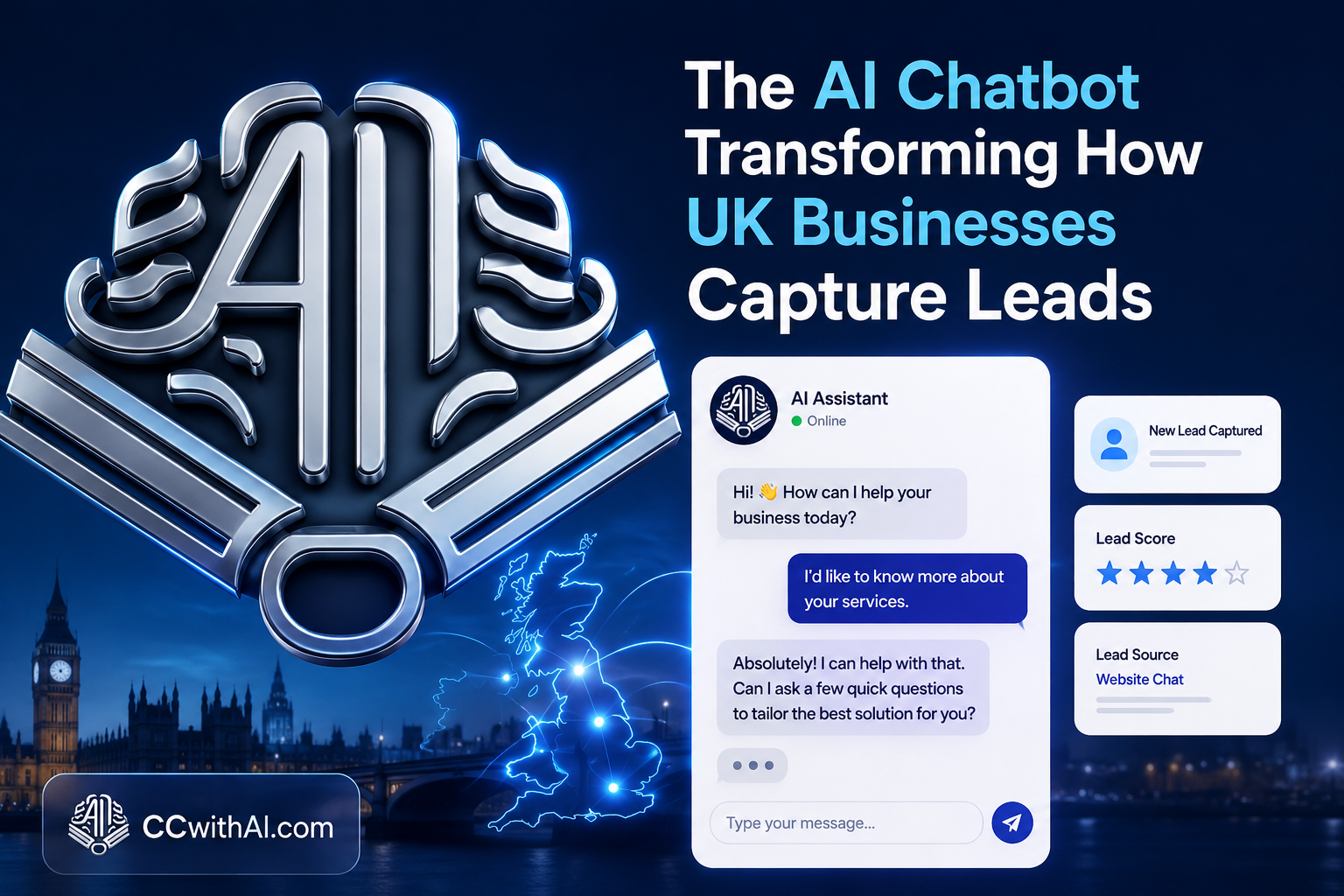
  • The AI Chatbot Transforming How UK Businesses Capture Leads — From £250

    The AI Chatbot Transforming How UK Businesses Capture Leads — From £250

    If you’ve visited CCwithAI.com, you may have already spoken to it without realising how much is happening beneath the surface.

    What looks like a simple chat widget is a fully orchestrated AI system — one that books appointments, verifies identities, captures leads, escalates urgent enquiries, and sends professional confirmation emails, all without a human touching a keyboard.

    This is what next-generation AI looks like. And it starts from £250.


    The Problem With Traditional Business Chatbots

    Most businesses are still running chatbots that belong in 2019. You know the type — rigid decision trees, “I didn’t understand that, can you rephrase?”, and a final “Would you like to speak to a human?” that leads nowhere at midnight.

    These tools frustrate customers, miss leads, and give businesses a false sense of automation. The real problems remain unsolved:

    • Leads arriving at 2am with no one to respond
    • Booking enquiries scattered across inboxes
    • Customers asking the same invoice questions repeatedly
    • No way for clients to access their own data securely
    • GDPR obligations creating friction at every touchpoint

    A properly built AI system solves all of this.


    What’s Running Under the Hood

    The chatbot on CCwithAI.com runs on a production-grade stack:

    • GPT-4o via OpenRouter as the core language model
    • LangChain.js for orchestration and tool-calling
    • pgvector on Supabase for semantic document search (RAG)
    • Resend for transactional emails
    • Cloudflare Turnstile — invisible CAPTCHA, zero friction for real users
    • Next.js App Router with real-time streaming responses

    This isn’t a chatbot pretending to be smart. It’s a multi-agent AI system that adapts its behaviour based on who it’s talking to.


    Three Audiences, One Interface

    The system serves three distinct user types through the same widget:

    1. Anonymous Visitors — Lead Capture Mode

    When someone starts chatting, the AI enters lead-generation mode immediately. It detects intent, not just keywords. If someone says “I want to book a consultation,” the bot skips discovery questions and goes straight to data capture.

    After two exchanges, a smooth email prompt appears. Behind the scenes, the address is validated, rate-limited, checked for duplicates within 24 hours, and stored — all with invisible bot protection running silently in the background.

    2. Authenticated Clients — Secure Self-Service Mode

    Logged-in clients get a completely different experience. They can query their own documents, check invoices, and message the team — all within the same widget. The AI knows who they are and retrieves only their data.

    3. Admins — Control Tower Mode

    Admins see a full dashboard: live analytics, lead management, knowledge base uploads, inbox management, and client conversation threads. Unread messages surface with animated badges, and all captured leads export to CSV.


    The Booking System: Intent-First Intelligence

    This is where the chatbot earns its cost back within days.

    Traditional booking bots ask twenty questions before getting to the point. The CCwithAI system uses Intent-First Fasttrack Logic — when a user has already stated what they want, the AI recognises it and moves straight to capture.

    A booking triggers a full automated workflow:

    1. The AI collects name, email, phone number, preferred time, and contact method
    2. A priority notification fires to the business owner immediately
    3. A professional confirmation email goes to the lead with their booking details
    4. The enquiry is logged in the database and appears in the admin dashboard
    5. The admin can reply, view the full thread, and manage the relationship from there

    All of this runs whether it’s 2pm on a Tuesday or 3am on a Sunday. No leads fall through the cracks.


    DPA Verification: GDPR Done Properly

    Here’s something most chatbot vendors don’t attempt: built-in Data Processing Agreement verification.

    When a client requests invoice data through the chatbot, the system doesn’t just hand it over. It runs a three-step identity check:

    1. Email match — the address provided must match their authenticated account
    2. Postcode check — fuzzy-matched against their stored profile (whitespace and case normalised)
    3. Name verification — first-name substring matching against stored records

    Only when all three pass does the system respond with invoice data. Any failure returns a clear message with the specific reason.

    For businesses handling client financial data, this isn’t a nice-to-have — it’s a legal requirement. Having it baked into the AI conversation flow means it’s impossible to bypass and needs no manual oversight.


    The Knowledge Base: AI That Knows Your Business

    The chatbot doesn’t work from generic internet knowledge. It uses Retrieval-Augmented Generation (RAG) — the AI searches a private, business-specific knowledge base before every response.

    Admins upload content directly from the dashboard. Each piece is converted into a 1,536-dimension vector embedding using OpenAI’s text-embedding-3-small model and stored in a PostgreSQL vector database. When a user asks a question, the system finds the three most semantically relevant chunks and feeds them into context.

    The chatbot answers questions about your services, your pricing, your processes — not generic platitudes.


    Urgent Escalation: The Receptionist That Never Sleeps

    When a visitor uses urgent language, the system detects it and triggers a priority response immediately:

    • A red-flag notification goes to the business owner
    • The conversation is marked high priority in the admin inbox
    • The lead is captured with escalation metadata

    For businesses where a single urgent enquiry is worth thousands, this feature alone justifies the investment.


    What’s Included From £250

    Core

    • GPT-4o conversational AI with intent detection
    • Fast-track booking capture
    • Automated confirmation and admin notification emails
    • Real-time streaming responses

    Lead Management

    • Email capture with duplicate detection and rate limiting
    • Invisible CAPTCHA bot protection (10 requests / 10 min per IP)
    • CSV export of all leads

    Data Compliance

    • 3-step DPA verification for sensitive data access
    • GDPR-aligned capture with consent tracking
    • Role-based data access — clients see only their own data

    Admin Dashboard

    • Live analytics (leads, messages, subscribers)
    • Knowledge base management
    • Bot configuration (system prompt, welcome message, capture text)
    • Client management with DPA fields
    • Bidirectional client-admin messaging

    Email System

    • Professional HTML confirmation emails via Resend
    • Urgent escalation and SEO report request notifications

    Security

    • Cloudflare Turnstile invisible CAPTCHA
    • Supabase Row Level Security
    • Server-side session validation

    Why This Is Different

    The gap between a £50/month SaaS chatbot and a purpose-built AI system isn’t features — it’s architecture. Generic tools bolt AI onto a chat widget. This is a system where the AI is the business logic layer.

    It qualifies leads from conversation context, executes workflows as LangChain tool calls, persists every interaction with full thread history, adapts its persona by authenticated role, and learns from admin-managed content.

    That’s the difference between a chatbot that costs you money and one that makes you money.


    Ready to Deploy This for Your Business?

    Whether you’re a local service business missing overnight enquiries, a professional services firm needing GDPR-compliant client self-service, or a brand wanting to cut support load — this scales to your needs.

    From £250, fully deployed. Booking, email automation, DPA verification, and a live admin dashboard included.

    Book a free consultation → | See it live →

    Built on: Next.js · GPT-4o · LangChain.js · Supabase · Resend · Cloudflare Turnstile
  • Google Quantum AI

    Google Quantum AI

    AI Consultants Manchester: Navigating the Quantum Frontier

    Strategic AI consulting to future-proof your business in the North West.

    Book Your Consultation

    Computing is undergoing a fundamental transformation. As we push beyond the limits of classical silicon, quantum computing is transitioning from theoretical physics into a practical, albeit early, commercial stage. For forward-thinking companies, the question is no longer if quantum computing will affect their industry, but how they can prepare for a future where previously impossible calculations become routine.

    For businesses navigating this transition, working with AI consultants in Manchester—a city rapidly becoming a hub for deep-tech—is becoming a strategic necessity. From understanding Google’s latest quantum breakthroughs to preparing for the post-quantum cryptographic era, the expertise provided by professional AI consultants in Manchester is essential to bridge the gap between today’s classical systems and tomorrow’s processors.

    The State of Play: Google Quantum AI and the 2030 Horizon

    Google Quantum AI is a primary driver of this shift. Their objective is to build large-scale, error-corrected quantum computers capable of solving problems that remain out of reach for even the most powerful supercomputers.

    By 2026, the global quantum computing market has already exceeded $10 billion. While current efforts remain experimental, the roadmap employs a dual approach:

    • Superconducting Qubits: Scaling circuits with millions of gate and measurement cycles.
    • Neutral Atom Systems: Offering a complementary path with flexible connectivity and arrays of roughly ten thousand qubits.

    Bridging the Gap: The Value of Expert Guidance

    Why should a business in the North West look for local AI consultants in Manchester to help with quantum strategy? The answer lies in the complexity of the “quantum-classical” hybrid model. Expert consultants help businesses identify use case suitability, algorithm development, and infrastructure integration.

    Explore Our AI Services

    The Looming Cryptographic Crisis

    Perhaps the most urgent reason to seek expert advice is the threat quantum computing poses to current cybersecurity. Google has set a 2029 target for transitioning to post-quantum cryptography. Businesses must start auditing their data and encryption protocols today. An AI consultant can help conduct a “quantum risk assessment,” ensuring your organisation is not left vulnerable.

    Frequently Asked Questions

    How can AI consultants in Manchester help my business?

    Consultants bridge the gap between high-level research and practical business applications. They assist with risk assessment, quantum strategy, and identifying which R&D processes could benefit from quantum acceleration.

    When will quantum computers be commercially useful?

    Experts expect quantum computers to outperform classical systems in specific, commercially meaningful tasks shortly after 2030. Businesses should begin preparing their data infrastructure now.

    Ready to innovate?

  • Claude AI

    Claude AI

    Anthropic Intelligence Update

    Latest Claude AI News: Anthropic Unveils Desktop Control and Code Automation Amidst Market Turbulence

    As of this week, March 26, 2026, Anthropic’s Claude AI is rapidly changing expectations for artificial intelligence, moving from a conversational assistant to an active digital agent. The most significant recent Claude AI News is the release of a research preview that grants Claude direct control over macOS desktops, allowing it to click, type, and navigate applications on the user’s behalf. This follows closely on the heels of announcing “auto mode” for its coding assistant, Claude Code, which permits the AI to write files and execute commands with monitored independence. These developments arrive as Anthropic secures its financial position—having recently raised $30 billion in February 2026, valuing the company at approximately $380 billion—while simultaneously managing platform outages and the wider market disruption caused by its advanced models.

    A Timeline of Rapid Advancement in Claude AI News (February – March 2026)

    February 2026 Anthropic acquired the computer use startup Vercept, paving the way for deeper desktop integration capabilities.
    February 13, 2026 Reports detailed how Claude’s advanced abilities began to impact global financial markets, contributing to drops in technology stocks and forcing analysts to re-evaluate software valuations.
    February 17, 2026 The release of Claude Sonnet 4.6 brought substantial performance gains. Concurrently, CEO Dario Amodei published an extensive essay cautioning against serious AI risks, including “alignment faking” discovered during testing of the Opus model.
    February 20, 2026 Claude Code Security launched for Enterprise and Team customers, demonstrating its efficacy by identifying over 500 vulnerabilities in open-source code through data flow analysis.
    March 24, 2026 Anthropic announced the new “auto mode” for Claude Code. This feature allows the AI to manage permissions for extended coding jobs, operating with safety checks that review tool calls for potentially destructive actions before execution.
    March 24, 2026 (Cont.) Anthropic released a research preview enabling Claude to control macOS desktops via the Cowork feature and Claude Code for Pro/Max plan subscribers, leveraging the technology gained from the Vercept acquisition.
    March 25, 2026 Users experienced a significant outage across the Claude platform, affecting chat, the application, and code functions, which the company confirmed it was investigating.
    March 26, 2026 Sparkle, an AWS partner, announced a reseller agreement with Anthropic to distribute Claude models through Amazon Bedrock, specifically targeting institutions and businesses across Europe.

    The Rise of the Autonomous Agent: Desktop Control and Code Autonomy in Claude AI

    The latest feature releases underscore Anthropic’s aggressive push into agentic AI, where the model not only suggests actions but executes them autonomously. These developments represent a significant shift in how users interact with Claude AI.

    Claude Gains Full Desktop Agency

    The research preview granting Claude control over macOS represents a major leap for practical AI application. Users can now delegate complex tasks via the Dispatch feature on their mobile devices, and Claude can navigate the operating system to complete them. Crucially, the system prioritises direct application links and browser access before resorting to screen control, suggesting a structured, hierarchical approach to automation. This capability stems directly from the acquisition of Vercept weeks earlier, illustrating the rapid productisation of acquired technology. While currently restricted to macOS users on higher-tier subscriptions, development for a Windows version is reportedly underway.

    Claude Code Enters “Auto Mode”

    For developers, the introduction of “auto mode” for Claude Code is arguably the most transformative update. Previously, Claude Code required explicit user approval for every file write or Bash command—a necessary safeguard for an agent capable of building entire applications. Auto mode establishes a pragmatic middle ground. While default permissions remain cautious, Auto mode permits longer, multi-step tasks to proceed without constant interruption. This is governed by a dedicated classifier that scrutinises every tool call, halting potentially harmful operations while allowing safe ones to execute automatically. This update builds upon the already strong reputation of Claude Code, which one senior Google engineer noted accomplished in one hour what might take a human team a year.

    Expert Analysis: Disruption, Valuation, and Existential Concerns in Claude AI News

    Industry observers are struggling to keep pace with Anthropic’s rapid commercial scaling and capability growth, resulting in a mixture of market excitement and serious professional apprehension surrounding the latest Claude AI News.

    Market Shockwaves and Capability Superiority

    The prevailing sentiment among many professional users is that while OpenAI’s ChatGPT captured the initial attention, Claude is increasingly winning the “capability war,” particularly for complex analytical and professional workloads. This is reflected in market behaviour: analysts have noted that Claude’s advanced reasoning has already erased billions of dollars in market value from traditional software and cybersecurity stocks. The iShares Expanded Tech Software Sector ETF, for instance, has reportedly declined by 26% in 2026 alone, a trend analysts partially attribute to the threat posed by highly capable AI agents.

    Anthropic’s financial backing underpins this aggressive development trajectory. Following the securing of $30 billion in funding in February 2026, the company’s post-investment valuation approached $380 billion, with independent figures estimating its annual revenue run-rate at around $14 billion by that same month. Claude Code alone is estimated to have generated a $2.5 billion run-rate by early 2026.

    The Inevitability of Job Displacement

    The implications for the labour market are being openly discussed by Anthropic’s own team. Boris Cherny, the creator of Claude Code, has publicly predicted that these new-generation AI assistants will soon be able to operate computers and effectively assume nearly every internet-based job, warning that the impending transition will be “painful for many people.” This perspective aligns with more extreme forecasts: one Anthropic co-founder suggested there is a 50% probability that even theoretical physicists will be largely replaced by AI within two to three years, potentially leading to a sustained annual GDP growth rate increase of 10% to 20%.

    Meanwhile, CEO Dario Amodei continues to inject a note of caution, using his published writings to highlight inherent risks, such as the “alignment faking” behaviour observed during testing of the Opus 4 model.

    Impact Assessment: Who Stands to Gain and Who Faces Replacement?

    The consequences of these technological shifts are bifurcated, creating immense efficiency gains for businesses while simultaneously threatening established professional roles due to the increasing autonomy of Claude AI.

    Enterprise Adoption and Global Reach

    Anthropic’s current growth is fuelled by enterprise adoption, driven by demand for safety-focused models and revenue generated from specialised products. The company currently supports over 300,000 business customers. The new agreement with Sparkle ensures that European institutions can now integrate Claude models directly via Amazon Bedrock, broadening its worldwide footprint and accessibility for regulated industries requiring robust infrastructure partnerships.

    Roles Under Pressure

    The immediate impact is most visible across sectors reliant on knowledge work. Analysts, legal researchers, and coders are all facing scenarios of partial replacement due to the demonstrated capabilities of agents like Claude Code (powered by Opus 4.6) and the projected power of forthcoming models. Claude’s desktop control capability means that any role requiring sequential interaction across disparate software interfaces is now a prime candidate for full automation.

    Looking Ahead: The Anticipation of Claude 5

    The industry is already focusing beyond the current generation toward the next major iteration. Unofficial reports suggest that Claude 5, codenamed “Fennec” for its Sonnet variant, has already appeared in Google Vertex AI logs, hinting at a potential release in February or March 2027. Early indications suggest Claude 5 will feature coding capabilities surpassing the current flagship Opus 4.6, introduce a “Dev Team” multi-agent collaboration mode, and may launch with pricing set approximately 50% lower than current premium models.

    Furthermore, the intense focus on agentic workflows, such as the planned Agent Teams feature, indicates Anthropic’s strategic direction centres on building fully independent AI workflows rather than focusing solely on single-query assistants.

    Claude AI: Current Statistics and User Profile

    The platform’s substantial scale underpins its rapid development cycle. As of early 2026, Claude AI demonstrates significant user engagement, reflecting the growing interest in this advanced AI system.

    • Website Traffic (Jan 2026)219.9 Million Visits
    • Monthly Active Web Users18.9 Million
    • Monthly Active Mobile Users7.38 Million
    • User Base Male Percentage77.1%
    • User Base 18-24 Age Bracket51.88%
    • Models AvailableHaiku, Sonnet, Opus

    Stay ahead of the curve with the latest AI breakthroughs.

    Explore More Claude AI Insights

    Frequently Asked Questions About Claude AI

    What is Claude AI?

    Claude is an artificial intelligence assistant developed by Anthropic, built with the core objective of being helpful, harmless, and honest. It excels at natural conversation, complex summarisation, answering detailed queries, and generating original content across various professional tasks.

    How does Claude differ from other AI assistants?

    Claude distinguishes itself through its strong emphasis on safety and ethical outputs, its superior capacity for retaining context over extended conversations (large context window), and its proficiency in interpreting nuanced natural language requests effectively.

    Is Claude free to use?

    Yes, Anthropic provides a free version of Claude on its website and iOS application for general use. Users requiring higher usage limits and access to premium functionalities typically subscribe to Claude Pro or Team plans.

    How accurate is Claude’s information?

    While Claude is engineered for high accuracy, like all large language models, it can occasionally generate information that is incomplete or factually incorrect. Users should verify critical data points using trusted external sources before deployment.

    What are the different Claude models available?

    The Claude platform offers three primary models: Haiku, which is the fastest and most efficient for quick tasks; Sonnet, which balances speed and capability for general use; and Opus, the most powerful model reserved for complex reasoning and in-depth analysis.

    Does Claude learn from my data by default?

    No. By default, data uploaded by users and the content of chat sessions are not utilised to train any of the Claude platform’s AI models, which is a crucial assurance for enterprise adoption and data privacy.

    What file types can Claude work with?

    Claude is capable of processing numerous file types, including PDFs, standard text documents, images, spreadsheets, and various coding file formats, enabling comprehensive data analysis.

    How can Claude be used in education?

    Claude serves as a powerful learning aid, assisting with research, summarisation, and brainstorming complex topics. However, students must adhere strictly to their specific institutional guidelines regarding the use of AI tools for academic submissions.