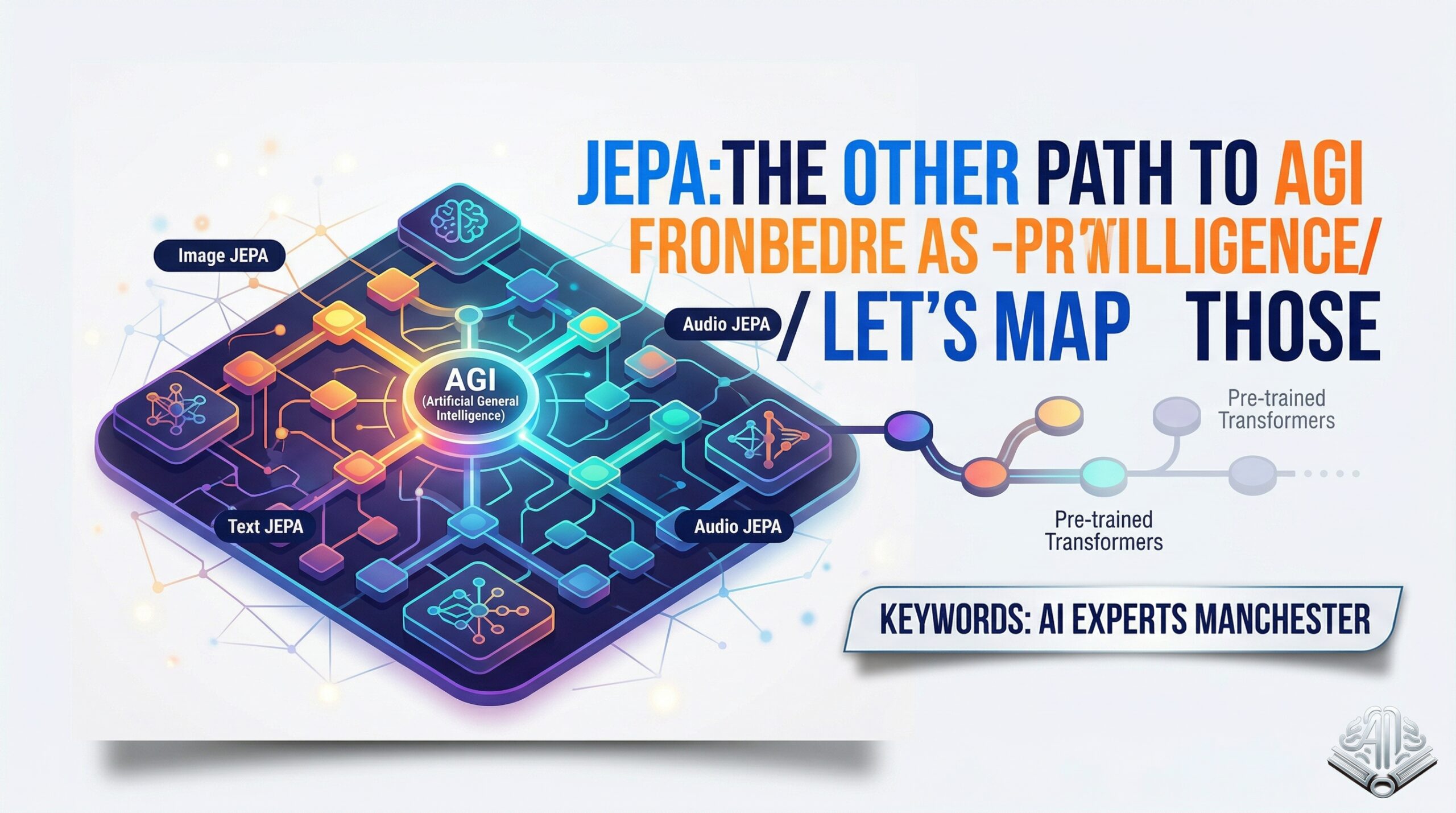
The artificial intelligence field experienced a significant shift in March 2026 following the release of the LeWorldModel (LeWM), a Joint-Embedding Predictive Architecture (JEPA) developed by Yann LeCun and researchers from Mila and AMI Labs. Unveiled on 13 March 2026, LeWM is the first JEPA capable of training stably from start to finish directly from raw pixels. It employs a simple objective featuring only two loss terms: one for predicting the next embedding and a regulariser that maintains a Gaussian distribution across the latent embeddings. This advance directly resolves the long-standing “representation collapse” issue that previously hindered earlier JEPA iterations. With AMI Labs reportedly raising over $1 billion in March 2026 to back this “World Model” approach, the industry focus is clearly moving away from predicting the next token towards building AI systems that possess genuine internal and causal comprehension of the world. This methodological pivot is already influencing technology hubs, including the demand for AI Experts Manchester who can implement these new world-modelling paradigms.
The JEPA Trajectory: From Theory to Practical World Modelling
For years, Yann LeCun has strongly argued that Large Language Models (LLMs), despite their impressive generative capabilities, represent a “dead end” for achieving true Artificial General Intelligence (AGI). This is because LLMs fundamentally lack a robust internal “world model”—the innate understanding of physics, cause-and-effect, and object permanence that humans possess.
JEPA, as a concept, offers an alternative learning philosophy. Instead of focusing on creating explicit outputs (such as the next word or pixel), JEPA learns by predicting the meaning or abstract representation of missing or future information. This abstract prediction space facilitates superior reasoning and, critically, is less susceptible to the hallucination problems common in purely generative systems.
Evolution of JEPA Architectures
The initial major step, concentrating on predicting the abstract mathematical representation of unseen regions within a single image.
Extended the concept across time, learning the “laws of physics” by predicting future video features.
Demonstrated the framework’s versatility by applying it to audio data, predicting latent features from spectrograms.
Established a shared “thought space” to align images and text conceptually, moving beyond simple token matching.
Linked the concept to embodied AI by predicting the necessary actions required to reach a target latent state.
The current pinnacle, achieving stable, end-to-end training from raw pixels to actions with minimal external guidance.
Anatomy of a World Model
A JEPA architecture relies on a complex interplay between encoders and predictors. The system typically comprises four primary components:
- Context Encoder: Transforms the observable portion of the input into a compact, abstract vector.
- Target Encoder: Transforms the hidden or future portion of the input into the “ground truth” vector.
- Predictor: Uses the output from the Context Encoder to estimate the output of the Target Encoder.
- Latent Variable ($z$): Allows the system to test various hypothetical “what if” scenarios within the abstract space.
Maintaining mathematical stability in these models has historically proven challenging, often leading to “representation collapse,” where the model opts for the easiest solution by mapping all inputs to an identical vector. LeWM circumvents this by employing the SIGReg (Sketched Isotropic Gaussian Regularisation) objective, which mandates that the latent space maintains a rich, bell-curve-like (Gaussian) spread, preventing the model from undermining the learning process.
Expert Consensus: The Missing Link for Embodied AI and AI Experts Manchester
The release of LeWM has generated substantial excitement, particularly among roboticists and researchers focused on embodied intelligence. Experts across professional platforms are hailing LeWM as the “missing link” required to construct truly capable humanoid robots. The shift towards world models is creating new opportunities for AI Experts Manchester specialising in next-generation robotics.
The primary advantage highlighted by analysts is speed. Traditional world models built upon foundation models often demand immense computational power for video generation. In contrast, LeWM demonstrates remarkable efficiency: it plans 48 times faster than foundation-model-based world models while maintaining high competitiveness across numerous 2D and 3D control tasks. Furthermore, LeWM itself is surprisingly compact, reportedly requiring only 15 million parameters and capable of training on a single GPU within a few hours.
Yann LeCun frames this divergence as a philosophical split in AI development. He posits that Generative AI (LLMs) represents “System 1” intelligence—fast, instinctual, and reactive—whereas JEPA is engineered for “System 2” intelligence—deliberate, reasoning-based, and capable of complex planning. LeWM’s success suggests that the pathway to AGI necessitates mastering System 2 skills first.
Impact Assessment: Redefining the AI Ecosystem
The emergence of LeWM and the JEPA methodology signals a significant redirection for the AI industry, moving beyond the generative focus that has dominated recent headlines.
Business and Market Implications
The transition from generating outputs to understanding underlying conditions carries substantial business ramifications. Entities utilising AI for critical decision-making, simulation, or physical interaction stand to benefit significantly.
- Making Advanced AI Accessible: The low computational overhead required to implement LeWM is transformative. Research data indicates that LeWM encodes observations using approximately 200× fewer tokens than DINO-WM, and VL-JEPA achieved 2x better performance than standard VLMs using only 50% of the trainable parameters. This efficiency democratises advanced world modelling for smaller firms and independent research groups, fostering a more diverse AI market, which benefits local talent pools like those in Manchester.
- Robotics and Autonomous Systems: For sectors such as manufacturing, logistics, and autonomous driving, JEPA offers a superior training paradigm. V-JEPA 2, for instance, has demonstrated success rates between 65% and 80% on pick-and-place tasks in novel environments, illustrating the strong generalisation capability essential for real-world deployment.
- Shifting Value Proposition: Investment is anticipated to pivot towards embodied AI and agents capable of intricate planning. The emphasis is moving away from models proficient at generating marketing copy towards models that can reliably navigate and interact with the physical environment.
Consumer and Scientific Applications
For the end-user, systems based on JEPA should offer greater reliability. Dependable chatbots that grasp causality, improved computer vision, and AI capable of complex, multi-step planning—rather than mere sequence matching—are set to become standard. In scientific research, JEPA’s capacity to efficiently model complex physical systems without reliance on massive text corpora opens new avenues for simulating chemistry, physics, and finance.
The Road Ahead: Hierarchical Reasoning and Agentic Behaviour
The immediate future for JEPA research centres on scaling and abstraction. Researchers identify H-JEPA (Hierarchical JEPA) as the next major frontier. These models aim to reason simultaneously across multiple timescales—comprehending both the immediate next action and the overarching strategic objective—a prerequisite for genuine general intelligence.
Other critical research avenues include:
- Improving Anti-Collapse Methods: While SIGReg proves effective, ongoing refinement of regularisation techniques, such as VICReg, will remain necessary as models increase in size.
- Latent Space Reasoning: Developing mechanisms for models to execute complex thought processes entirely within the abstract latent space, bypassing the need to translate internal cognition back into human language (text).
- Agentic Capabilities: Testing JEPA models on intricate chains of reasoning, tool utilisation, and sophisticated agent behaviours in both simulated and physical settings.
- LLM Integration: Investigating LLM-JEPA designs to enhance existing language models with superior reasoning and generalisation by grounding their outputs in a predictive world model.
- 3D-JEPA: Creating versions specifically optimised for spatial computing and advanced simulation environments.
The momentum surrounding LeWM suggests the AI community is embracing a fundamental methodological change, one that promises systems that are more dependable, efficient, and ultimately more intelligent, built upon a foundation of understanding rather than mere generation. This shift underscores the growing need for local technical expertise, such as that provided by AI Experts Manchester.
Frequently Asked Questions (FAQ) about JEPA and World Models
JEPA stands for Joint-Embedding Predictive Architecture. It is a self-supervised learning method designed to learn useful representations by predicting the abstract mathematical embeddings of hidden or masked data regions based only on the visible context, instead of attempting to recreate the raw input signals (like pixels or words).
LLMs are predominantly generative and autoregressive, meaning they predict the next item in a sequence. JEPAs, conversely, operate within an abstract representation space, learning by predicting the embedding of missing information. This focus on abstract prediction makes JEPAs better suited for learning causal world models.
LeWM, released in March 2026, is significant because it is the first JEPA architecture proven to train stably from start to finish directly from raw pixels. It achieves this stability using only two loss terms and successfully resolves the representation collapse problem that troubled earlier models.
Representation collapse occurs when the model simplifies the learning task by mapping all inputs to an identical, useless vector, or by restricting variation to very few dimensions. This renders the learned embeddings ineffective for subsequent tasks requiring detailed comprehension.
SIGReg (Sketched Isotropic Gaussian Regularisation) is a key mathematical technique employed to prevent representation collapse. It requires that the high-dimensional latent representations generated by the model adhere to an isotropic Gaussian (bell curve) distribution, ensuring the model explores the full spectrum of possibilities.
H-JEPA stands for Hierarchical JEPA. It is an extension of the architecture engineered to enable the model to reason effectively across multiple timescales and levels of abstraction concurrently, which is essential for complex planning and strategic decision-making.
LeWM demonstrates planning speeds up to 48 times faster than foundation-model-based world models. Related models like VL-JEPA show 2x better performance than conventional VLMs using only half the trainable parameters. Furthermore, V-JEPA 2 achieves success rates between 65% and 80% on novel pick-and-place robotics tasks.
Not necessarily. LLMs excel at tasks requiring fluent text generation and broad knowledge recall (“System 1”). JEPA excels at constructing internal world models, causal reasoning, and planning (“System 2”). The future trajectory likely involves hybrid systems (such as LLM-JEPA) that merge the strengths of both architectures.